Oct 19, 2026
Ordering Custom Hoodies? Weight and Construction Decide More Than Design
Hoodie weight sets the season and the price tier, blend sets shrinkage and pilling, and four visible construction details decide how the garment ages.
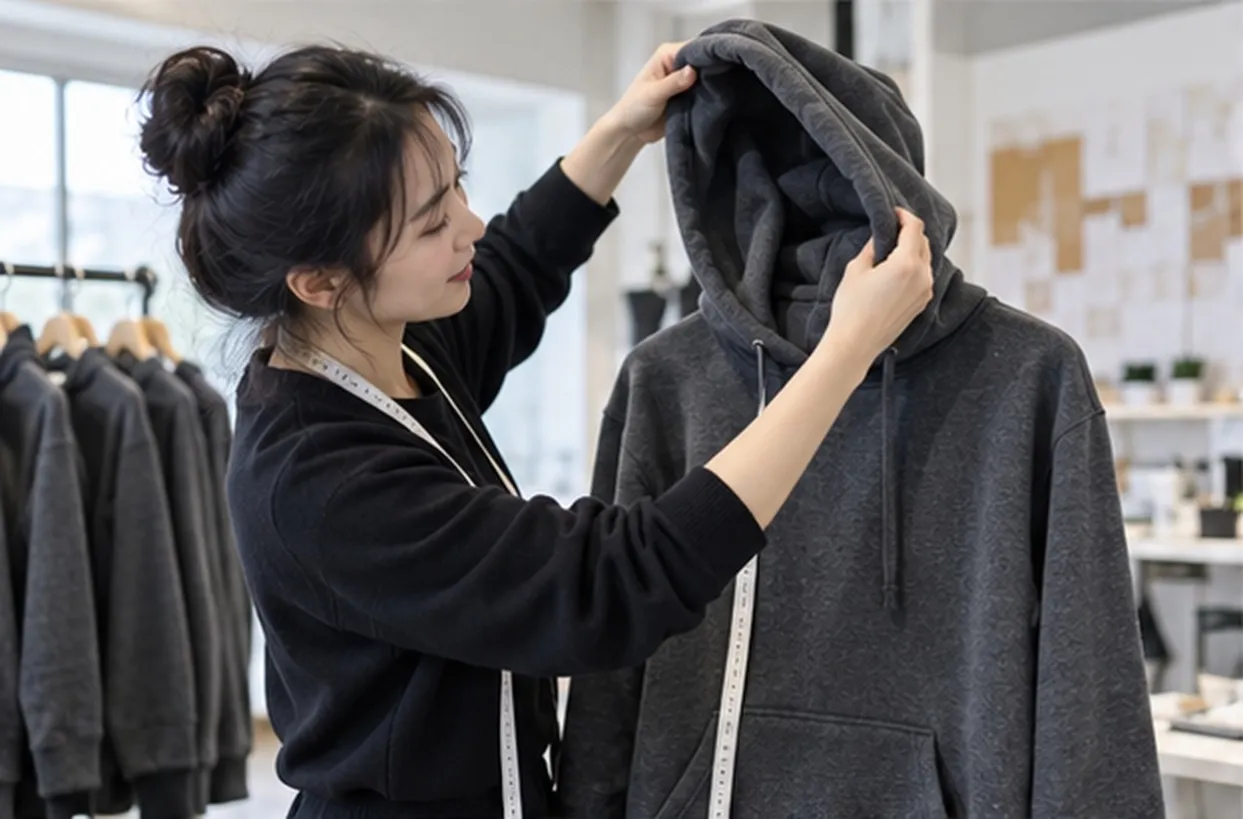
Two hoodies with the same logo can read as a premium garment and a promotional giveaway, and the difference is grams per square metre.
Ordering custom hoodies means choosing the fabric weight first, then the blend, then the construction details that show on the outside: the hood shape, the pocket attachment, the rib and the seam. A heavier hoodie at the same decoration cost carries a different retail price, and the weight decision cannot be changed after the fabric is cut.
Below: how weight changes what a hoodie is for, how blend affects handfeel and shrinkage, which construction details are visible, how to decorate a hood without ruining it, and what to confirm before the run starts.
How does fabric weight change what a hoodie is for?
Weight decides the season, the price tier and how the garment photographs.
Hoodie weight sets the garment's job: a mid-weight fleece works as a three-season layer, a heavy loopback or brushed fleece becomes an outerwear piece, and a light terry reads as a summer throw-on. Choose the weight from the season and the price tier you are selling into, not from what the sample happens to be.
What weight actually measures
Weight is measured in grams per square metre and it correlates with heft, opacity and warmth. It also correlates with cost, because heavier fabric consumes more yarn.
Three practical tiers cover most programmes. A mid-weight fleece suits staff uniform and event merch. A heavy fleece suits retail-oriented brand product and outerwear layering. A lighter terry or French terry suits warm-climate programmes and summer events.
Weight tier · Behaviour · Typical use
Light terry · Breathable, drapes, lower warmth · Summer events, warm markets
Mid-weight fleece · Three-season, holds shape · Staff uniform, event merch
Heavy fleece · Structured, warm, premium feel · Retail product, outerwear layer
Why the weight must be locked before decoration
Decoration is priced and tested against a specific fabric. A print that performs on heavy fleece can crack differently on light terry, and an embroidery backing that suits one weight is wrong for another.
Once the fabric is cut, the weight cannot change without restarting the run.
✔ Hoodie weight should be chosen from the season and price tier, not from a sample True Weight determines warmth, structure and cost, which together define what the garment is for. An available sample is not a specification.
✘ Heavier fleece is always the better purchase False Heavy fleece is unwearable in warm climates and overbuilt for a giveaway. Weight should match the season the garment will be worn in.
How does blend affect handfeel and shrinkage?
The blend decides how the garment feels after ten washes, not how it feels in the shop.
Blend determines shrinkage, pilling and how the inside of the garment ages. Cotton-rich fleece feels better initially and can shrink more; a cotton-polyester blend shrinks less and resists pilling but feels drier. Ask for the blend as a ratio and a shrinkage figure, not as a description like cotton-rich.
Three numbers for the blend
Three numbers make the blend decision concrete. The cotton to polyester ratio, written as a ratio rather than an adjective. The shrinkage figure, expressed as a maximum percentage per direction after a stated number of washes. And the pilling grade, which predicts how the surface looks after a month of wear.
The ratio matters for repositioning. A cotton-rich hoodie can be sold as a premium garment. A high-polyester hoodie is a promotional item, and should be priced and presented as one.
Property · What to ask · Why it matters
Blend ratio · Cotton and polyester as a written ratio · Determines position and price tier
Shrinkage · Maximum percent, length and width · Fit drifts after the first washes
Pilling · Minimum grade for the fabric · Surface looks worn early if it pills
Weight · Grams per square metre · Season and price tier
The inside of the hoodie is a specification too
Brushed fleece has a soft interior that shows quality on first wear and can pill with washing. Loopback is firmer, cooler and wears more evenly. For uniform programmes, loopback often lasts better; for retail, brushed sells better on the hanger.
✔ A cotton-rich blend and a higher-polyester blend suit different programmes True Cotton-rich feels better initially and can shrink more. Higher polyester shrinks less and resists pilling, which suits uniform programmes and promotional pricing.
✘ Blend descriptions such as cotton-rich are enough to specify a hoodie False An adjective does not state a ratio or a shrinkage figure. Both need to be written as numbers in the order.
Which construction details are visible?
Four details show on the outside and separate a good hoodie from a cheap one.
The hood shape, the pocket attachment, the rib quality and the seam type are the four visible construction decisions. A double-layer hood holds its shape, a kangaroo pocket that is bar-tacked at the corners survives use, and a rib with elastane recovers instead of stretching out.

Start with the hood. A single-layer hood collapses and looks flat in photographs. A double-layer hood keeps a structured shape and reads as a better garment.
Then the pocket. A pocket sewn only along the top edge pulls away at the corners. Bar-tacks at the stress points cost little and prevent the most common failure.
The rib matters at cuff and hem. A rib without elastane stretches and stays stretched. A rib with elastane recovers, which is what keeps the cuff looking new.
Seams are the fourth. Flatlock seams lie flat and suit activewear; overlocked seams are standard on fleece. Both are fine, but the choice should match the intended use.
Detail · What to specify · Failure if ignored
Hood · Double layer · Collapses, photographs flat
Pocket · Bar-tacked corners · Pulls away under use
Rib · Contains elastane · Cuff and hem stretch out
Seam · Flatlock or overlock, stated · Wrong construction for the use
✔ A double-layer hood holds its shape and photographs better True A single-layer hood collapses and reads flat. The double layer is one of the few construction upgrades visible from the outside.
✘ Pocket bar-tacks are a cosmetic detail with no functional value False A pocket sewn only along the top edge pulls away at the corners under use. Bar-tacks prevent the most common hoodie failure at negligible cost.
How do you decorate a hood without ruining it?
Print and embroidery both work on a hood, with different constraints.
Decorating a hood requires checking the drawing surface: a print across the chest is straightforward, a print over the hood seam is not, and embroidery on a double-layer hood needs the backing calculated for two layers. Confirm the placement against the actual hood construction before approving artwork.
Placement by panel
Chest prints are the safest placement and the most common. A large back print works but needs a flat panel, which a hood does not have.
Embroidery on the chest is straightforward on most fleece. On the hood itself, the double layer changes the stitch count and the backing, and the result can pucker if it was priced as single-layer.
Sleeve prints suit small marks and read as a detail rather than a statement.
Placement · Works on fleece · Watch for
Left chest print · Yes · Standard, safest
Full back print · Yes · Flat panel required
Hood surface · Limited · Double layer, puckering
Sleeve · Yes · Small marks only
Cuff or pocket · Rarely · Curved, moving surface
✔ Embroidery on a double-layer hood needs backing calculated for two layers True The stitch count and backing change with the layer count, and pricing it as single-layer can produce puckering that cannot be corrected later.
✘ A full back print works the same on a hood as on a t-shirt False A hood has no flat back panel. A large back print needs a flat surface, which is why chest and sleeve placements dominate on fleece.
What should be confirmed before the run?
Weight, blend, colour, size chart, decoration placement and the shrinkage figure.
Confirm six things before a hoodie run: the fabric weight in grams, the blend ratio, the colour reference, the size chart measured flat, the decoration placement with its size, and the shrinkage figure the supplier will hold. Anything not written down becomes an assumption at inspection.
The size chart deserves specific attention because hoodies are worn oversized. Decide whether the cut is true to size or deliberately relaxed, and state it, because a size chart that does not say produces disagreement about whether the garment is correct.
Colour follows the usual rule: a physical reference, not an adjective. Two people discussing grey are often picturing different greys.
✔ Fabric weight should be chosen from the season and price tier, not from a sample True Weight determines warmth, structure and cost, which together define what the garment is for. A sample that happens to be available is not a specification.
✘ A cotton-rich blend is always better than a blend with more polyester False Cotton-rich feels better initially and can shrink more. A higher polyester content shrinks less and resists pilling, which suits uniform programmes and promotional pricing.
Conclusion
Lock the weight first, then the blend, then the details that show. Confirm the shrinkage figure and the size chart in writing.
Motion coordinates custom apparel projects with selected production partners, from brief and sample confirmation through production follow-up and delivery coordination.