Oct 19, 2026
Building Branded Merch Kits? How to Decide What Actually Goes In Them
A merch kit is decided by minimums and packing, not by the logo: choose three to five useful items, check each minimum, and measure the box after the items are chosen.
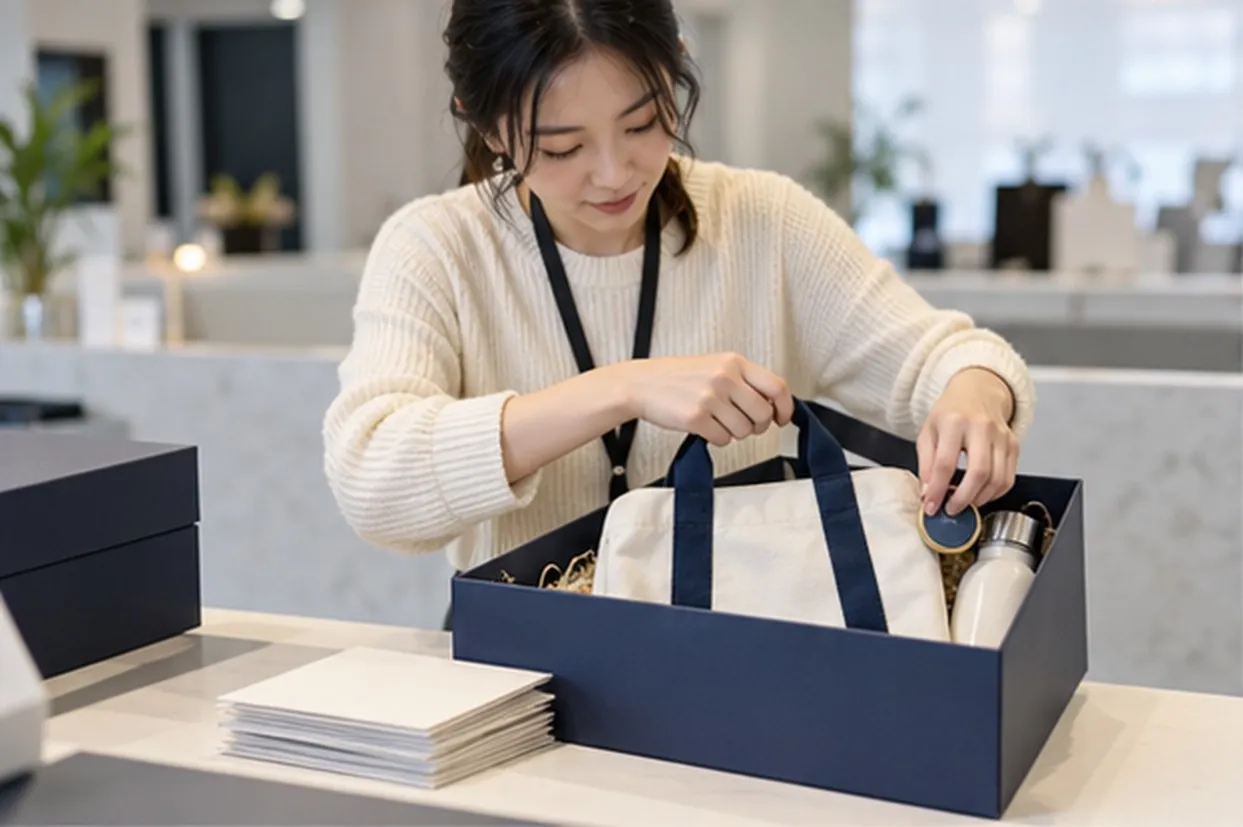
A merch kit looks like a gift and behaves like a logistics problem: four items, three suppliers, one delivery date.
Building a branded merch kit means choosing items that survive the trip, sizing the quantity to the smallest item's minimum, keeping decoration consistent across materials that behave differently, and packing to a box that was measured rather than guessed. Start from the bag and work outwards, not from the logo and work inwards.
Below: how to choose the items, why minimums decide the kit before design does, how decoration changes across fabric, metal and ceramic, how to pack without damage, and what to confirm before the first kit ships.
How do you choose what goes into a branded merch kit?
Choose items the recipient will keep, and choose fewer of them than you think.
A merch kit should hold three to five items chosen for daily use, not a collection of branded objects. One item people actually carry, one they use at a desk, and one consumable creates a kit with a purpose; eight branded items create a box that gets stored unopened.
The buy-it-themselves test
The test is simple: would the recipient buy this themselves? A tote bag, a water bottle and a notebook pass. A branded stress ball and a branded keyring do not.
Kits fall into three useful types. A welcome kit for new staff, which needs durability. An event kit for attendees, which needs portability. A client gift kit, which needs presentation. Each type has a different item spine.
Kit type · Item spine · What it optimises for
Staff welcome kit · Tote, bottle, notebook, pin · Daily use over years
Event attendee kit · Lanyard, sticker pack, small tote · Carrying things for one day
Client gift kit · Gift box, tumbler, pin, card · Presentation on opening
Match the item to the audience
A crew that works outdoors needs a bottle that survives a drop. A desk-based team needs an item that sits on the desk without looking like a giveaway.
The same logo on the wrong item reduces perceived quality. A ceramic mug in a kit for field staff reads as a guess; an insulated tumbler does not.
✔ A merch kit should hold three to five items chosen for daily use True Recipients keep items they would have bought themselves. A kit of eight branded objects gets stored unopened, while three useful items get used.
✘ More branded items make a kit feel more generous False Extra low-use items dilute the kit and raise cost. A narrow kit of items people carry sends a clearer message than a wide kit of objects.
Why do minimums decide the kit before design does?
Because every item in the kit carries its own minimum, and the kit can only be built to the smallest one.
Each item in a merch kit has a separate minimum order quantity, usually set by the item type rather than the kit: canvas totes, hard enamel pins, tumblers and gift boxes each start at a different figure. The kit quantity is capped by whichever item has the largest minimum, so choose items with compatible minimums before designing anything.
Where kits blow the budget
This is the constraint most kits hit. A team of forty with a gift box that has a five-hundred unit minimum produces four hundred and sixty boxes in storage.
Three practical moves follow. First, check each item's minimum before committing to it. Second, consider substituting a near-equivalent item with a lower minimum rather than reducing the kit quantity. Third, where a minimum exceeds the audience, decide deliberately whether the surplus is acceptable stock or a reason to change the item.
Item · Minimum pressure · Typical substitute
Canvas tote · Moderate · Poly mailer bag, lower minimum
Hard enamel pin · High · Sticker pack
Insulated tumbler · High · Water bottle
Custom gift box · High · Plain box plus branded band
When to break a kit into two orders
If one item's minimum is far above the kit quantity, running it as a separate second order for a later event is usually better than holding stock.
The exception is a consumable that will be used across the year, where surplus is inventory rather than waste.
✔ A merch kit is capped by the item with the highest minimum order quantity True Each item carries its own minimum, and the kit cannot be built below the largest of them without accepting surplus on that item.
✘ Substituting a lower-minimum item always reduces kit quality False A poly mailer bag in place of a canvas tote removes a stock problem without changing the kit purpose. The substitution is a logistics decision.
How does decoration change across fabric, metal and ceramic?
Every material takes a different method, and the methods do not look identical.
Decoration differs by substrate: embroidery and print on fabric, laser or print on metal and drinkware, and print or epoxy on pins. The same artwork will not reproduce identically across these surfaces, so a kit needs one primary method on the hero item and consistent colour treatment on the rest.
Three rules for coherence
Three rules keep a kit coherent. Keep the mark small on every item, because a large mark on a small object looks applied rather than designed. Keep one colour treatment, either a single brand colour or one-colour white or black. And accept that a screen-printed logo on canvas and a printed logo on a tumbler will not match exactly, so do not put them side by side in the presentation.
Fabric items can carry embroidery where available, which reads as a premium detail and survives washing. Drinkware usually carries print. Pins carry enamel colour, which is the closest to a flat brand colour and the hardest to match against fabric.
Substrate · Common method · What to watch
Canvas tote · Screen print, embroidery · Ink on textured weave
Garment in the kit · Embroidery, print · Colour on dark fabric
Tumbler, bottle, mug · Print · Curved surface, wrap limit
Hard enamel pin · Enamel fill · Colour match to brand
Sticker · Die cut print · Adhesive on textured surfaces
✔ The same artwork will not reproduce identically across fabric, metal and enamel True Each substrate takes a different method with its own colour behaviour. A kit stays coherent through scale and colour discipline, not identical reproduction.
✘ A large logo on a small object looks more premium False A large mark on a small object reads as applied rather than designed. Keeping the mark small is what makes the kit look intentional.
How do you pack a kit without damage?
Measure the box around the contents, not the contents into a standard box.
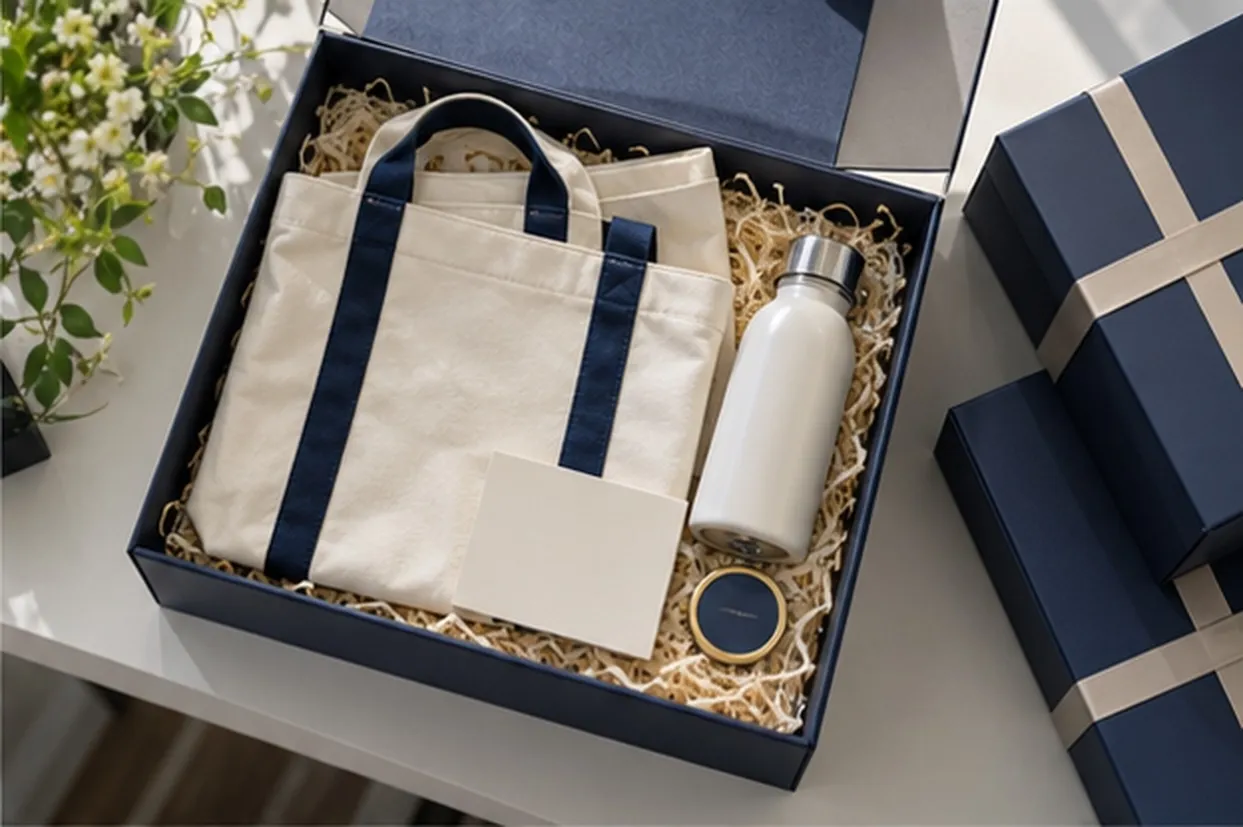
Pack a merch kit by measuring the assembled contents and specifying a box to that size, with a filler layer between hard and soft items. A box chosen before the items are confirmed either crushes the garment or arrives oversized, and an oversized box with loose contents damages the drinkware in transit.
Two packing failures
Two failures are common. Items shift inside an oversized box and the drinkware takes the impact. Or a rigid box with no inner layer transfers pressure to a pin or a mug.
The practical arrangement is soft items against the box walls as cushioning, hard items in the centre, and a card or a wrap on top. For shipping rather than hand delivery, an outer carton is required on top of the presentation box.
Layer · Purpose · Note
Outer carton · Protects in transit · Required for shipping
Presentation box · The opening experience · Measured to contents
Filler or wrap · Prevents movement · Soft items can serve this role
Card · Message and instructions · Printed separately, low minimum
✔ A presentation box should be measured after the contents are confirmed True A box chosen before the items exist either crushes the garment or arrives oversized, and loose contents damage drinkware in transit.
✘ Soft items cannot serve as packing protection False A folded garment against the box wall cushions a hard item in the centre. Soft items are the cheapest filler available in most kits.
What has to be confirmed before the first kit ships?
The item list with minimums, the decoration method per item, the box dimensions, and the delivery date for the assembled kits.
Confirm four things before a merch kit order is placed: each item's minimum order quantity, the decoration method and placement per item, the finished box dimensions, and whether kits are assembled before delivery or packed flat. Assembly location changes both the cost and the delivery date.
Assembly is the line that catches people out. If kits are assembled before shipping, someone counts and packs, which takes time and needs a workspace. If they ship flat, the recipient assembles, which is fine for handouts and wrong for a client gift.
Delivery date needs the same treatment as any apparel order: a date for the items, a date for the boxes, and a date for assembly. The last date is the one that matters.
✔ A merch kit quantity is limited by the item with the highest minimum order quantity True Each item carries its own minimum, and the kit cannot be built below the largest of them without accepting surplus on that item.
✘ The same logo reproduces identically on canvas, ceramic and enamel False Each substrate takes a different decoration method with its own colour behaviour. A kit stays coherent through scale and colour discipline, not through identical reproduction.
Conclusion
Choose three to five items people will use. Check every minimum. Keep the mark small on every surface. Measure the box after the items are chosen.
Motion coordinates custom apparel projects with selected production partners, from brief and sample confirmation through production follow-up and delivery coordination.