Oct 19, 2026
Suiting a Management Team? How to Run a Corporate Suiting Programme
A suiting programme is a wardrobe standard, not a group order: lock one repeatable cloth, measure against a chart, and archive the spec so new joiners still match.

A corporate suiting programme is not a group order. It is a wardrobe standard that has to survive staff changes for years.
Suiting a management team means setting one cloth and silhouette as the company standard, collecting measurements per person against a measured chart, ordering in one batch for colour consistency, and keeping the specification so new joiners can be fitted to the same standard later. The programme matters more than the first order.
Below: what a suiting programme is for, how to choose the cloth standard, how to measure a team that is never in one room, how to handle sizing across very different builds, and what records make the second year work.
What is a corporate suiting programme actually for?
It sets a standard, not a uniform. The point is that two people from the company look like they belong to the same organisation.
A corporate suiting programme establishes one approved cloth, colour and silhouette that everyone in scope is fitted to, so that any two people from the company appear consistent regardless of when they were fitted. The value is consistency over years, not a single delivery.
What changes once it is a programme
That distinction changes the decisions. A group order optimises for one delivery. A programme optimises for the next five years of joiners.
Three things follow. The cloth and colour must be repeatable, which means confirming the supplier can source the same reference later. The size chart must be recorded, so a new joiner is measured to the same standard. And the specification must be archived, so a replacement jacket matches the existing one.
Question · Group order · Suiting programme
Optimises for · One delivery · Consistency across years
Cloth decision · Whatever suits the event · Whatever can be re-sourced
Size record · Discarded after delivery · Archived for new joiners
Success measure · Everyone dressed on the day · Everyone still matching in year three
✔ A suiting programme is judged by consistency across years, not the first delivery True New joiners keep arriving, and the programme succeeds when they can be fitted to the same standard without a redesign.
✘ A corporate suiting programme is the same thing as a group order False A group order optimises for one delivery. A programme optimises for the next several years of joiners, which changes every decision.
How do you choose a cloth standard that will still exist later?
Choose for repeatability before appearance.
Choose a suiting cloth that the supplier can confirm as repeatable, in a colour that photographs consistently, at a weight that suits the climate the team works in. A cloth chosen for how it looks in one showroom is useless if it cannot be sourced again for next year's joiner.
Three properties of a repeatable cloth
Three properties matter. Repeatability, which is a supplier answer rather than a fabric description. Colour stability, because a standard that reads differently under office lighting and daylight is not a standard. And weight, because a heavy cloth in a hot climate is worn less often than a light one.
Climate deserves its own line. In humid markets, a lighter and more breathable cloth gets worn; a heavy flannel gets left in the wardrobe. The programme should be built for how often the suit will actually be worn.
Property · What to confirm · Consequence if wrong
Repeatability · Supplier can re-source the same reference · New joiner cannot be matched
Colour stability · Reads consistently across lighting · Two standards in one office
Weight and season · Matches the climate worn in · Suit stays in the wardrobe
Care requirements · Compatible with available cleaning · Garment ages unevenly
One cloth or two
A single cloth simplifies everything, and is the right choice for most programmes. A second cloth is justified only when the team spans genuinely different climates or when two levels of seniority need a visual distinction.
✔ Repeatability is a supplier answer, not a fabric description True A cloth that cannot be confirmed as re-sourceable cannot hold a multi-year standard, however good it looks in a showroom.
✘ Cloth weight is irrelevant once the colour is agreed False Weight determines whether the suit gets worn in the climate it was bought for. A heavy cloth in a hot market stays in the wardrobe.
How do you measure a team that is never in one room?
With one chart, one collector and one deadline.
Measure a distributed team by publishing a measured garment chart, naming one collector, and setting a single cutoff. Ask each person to measure a jacket they already own and like rather than their own body, because garment measurements are reproducible and body measurements taken at home are not.
The problem is the spread
The spread is the problem. Leadership teams are rarely in one place, and the people being measured are usually the least available for a fitting.
Two steps make it workable. Publish the chart showing chest, shoulder, sleeve and waist measured flat on a garment. And ask for one garment measurement, not a body measurement, from each person.
For anyone senior enough to be fitted in person, do that instead. The measurement chart is a substitute for a fitting, not an improvement on one.
Method · Who it suits · Reliability
In-person fitting · Anyone accessible · Highest
Garment measurement from an owned suit · Distributed team · Moderate to high
Body measurement at home · Last resort · Low to moderate
Trial garment before the run · Small teams with time · Highest, slowest
✔ Garment measurements from an owned suit are more reliable than home body measurements True A garment measurement is reproducible. Home body measurements vary with posture, method and who holds the tape.
✘ A measurement chart replaces the need for a fitting entirely False The chart is a substitute for people who cannot be fitted in person. For anyone accessible, an in-person fitting is still better.
How do you handle very different builds in one standard?
With a size chart that has enough grades, and a willingness to treat outliers individually.
Handle mixed builds by confirming the size range covers the extremes before the order is placed, and by fitting outliers to their own measurements rather than to the nearest standard size. A programme that only covers the middle of the range will produce two people whose suits do not look like the rest.
Where the range runs out
Most suiting ranges grade from a small chest to a large one. The people who break the programme sit outside that range or proportioned differently within it.
Two practical responses. Confirm with the supplier what happens at the top and bottom of the range, and whether a made-to-measure option is available for those cases. And fit the outliers individually rather than pushing them into the nearest size, because a badly fitted suit in a consistent programme looks worse than a well-fitted exception.
Case · Approach · Why
Within standard range · Order from the size chart · Consistent and quickest
Above or below range · Made to measure for that person · The programme should not force a bad fit
Different proportion · Adjust the measuring reference · Shoulder and sleeve may need separate handling
Returning staff · Reuse the archived measurement · Confirm it still holds
✔ Outliers should be fitted individually rather than pushed into the nearest size True A badly fitted suit inside a consistent programme looks worse than a well-fitted exception. The standard is the cloth and colour, not one pattern.
✘ A size range that covers the middle covers a management team False Leaders vary in build as much as any group. Confirm what happens at the top and bottom of the range before the order is placed.
What records make the second year work?
The cloth reference, the size chart with its approval date, and each person's measurements.
Keep three documents: the approved cloth reference with its supplier confirmation, the size chart as approved, and a per-person measurement record. With those, a new joiner can be fitted into the existing standard, and a replacement jacket can be made to match rather than resemble.
The per-person record is what most programmes skip. It is also the one that saves the most time later, because a returning member of staff does not need to be measured again.
The cloth reference needs to be more than a name. It needs the supplier's confirmation that the reference is repeatable, ideally with a physical swatch kept on file.
✔ A per-person measurement record saves time on returning staff True Someone measured in year one does not need to be measured again in year three unless their build changed. The record is the reason.
✘ The cloth name is enough to identify a standard later False A name does not confirm re-sourceability. The record needs the supplier confirmation and ideally a physical swatch on file.
What should the decoration do on a suit?
Keep it small, and keep it off the wear points.
Decorate corporate suiting in the least visible place that still identifies the company: a small chest mark or an inside label rather than a prominent logo. Suiting is judged as clothing first, and a large mark on a suit reads as a uniform, which is usually not the intention for a management team.
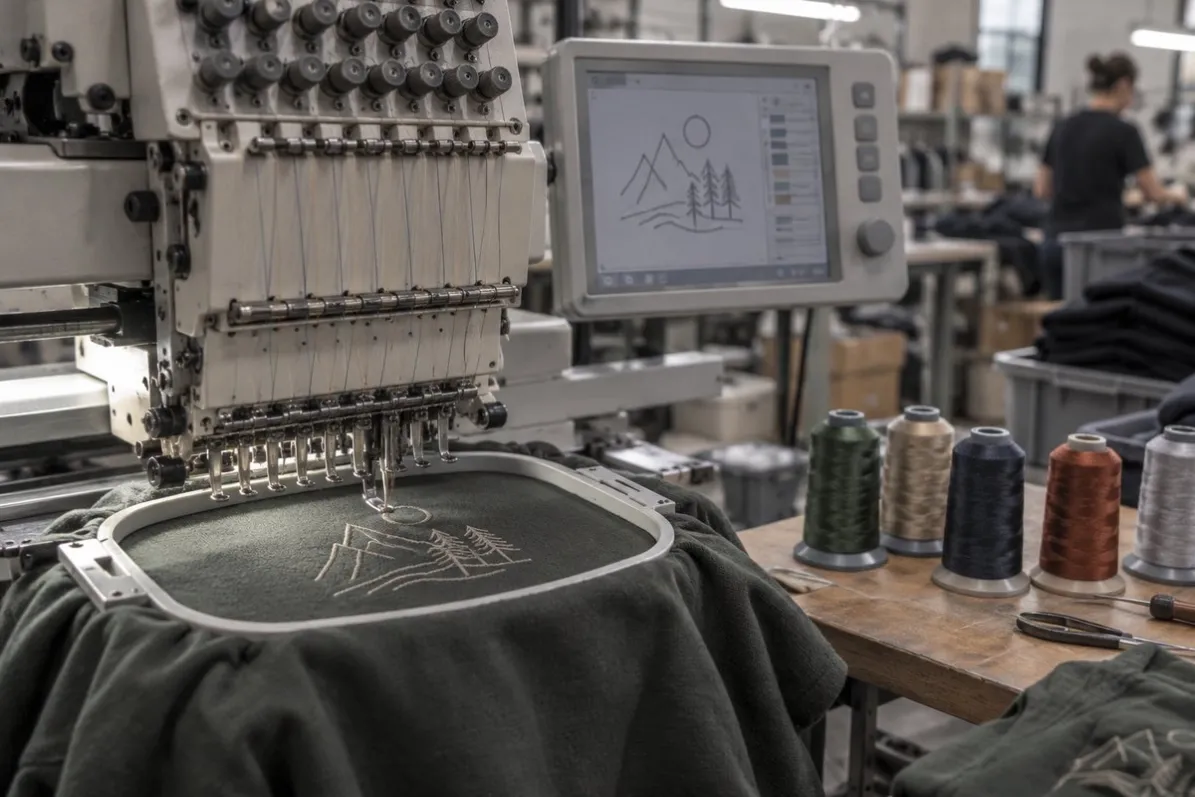
Two placements work. A small embroidered mark on the chest, if the company wants one. And an inside label or a small mark at the cuff, which is discreet and reads as a detail.
Anything across the back or on the lapel changes the garment's character. It should be a deliberate decision, not a default.
✔ A suiting programme is judged by consistency across years, not by the first delivery True New joiners keep arriving, and the programme succeeds when they can be fitted to the same standard without a redesign. The first order is the easy part.
✘ Any suiting fabric can be re-sourced later in the same colour False Repeatability is a supplier answer, not a fabric description. A cloth that cannot be confirmed as re-sourced cannot hold a multi-year standard.
Conclusion
Set one repeatable cloth. Measure against a chart, not a memory. Fit the outliers individually. Archive the spec and the measurements.
Motion coordinates custom apparel projects with selected production partners, from brief and sample confirmation through production follow-up and delivery coordination.