Oct 19, 2026
Launching a Custom Activewear Set? What to Decide Before You Sample
Activewear has to be specified by stretch recovery and opacity, tested in motion rather than standing still, and decorated with methods that flex with the fabric.

An activewear set is the hardest garment to sample well, because stretch behaves differently from everything else in the catalogue.
Launching a custom activewear set means deciding the fabric's stretch and recovery before the cut, confirming opacity under stretch, choosing a coordinated set or separates, and testing the fit on a body in motion rather than standing still. A set that photographs well and goes sheer in a squat is not sellable.
Below: why stretch changes the sampling logic, how to check recovery and opacity, whether to launch a set or separates, what decoration survives on stretch fabric, and what to confirm before bulk.
Why does stretch change the sampling logic?
Because a stretch garment is judged in movement, and movement is not visible on a hanger.
Stretch fabric has to be specified by recovery and opacity under stretch, not only by weight and composition. An activewear set that fits standing still can fail the moment the wearer moves, and the failure is visible to the wearer before anyone else notices.
What a normal sample misses
Standard sampling checks fit at rest. Activewear needs three additional checks: does the fabric return to shape after stretching, does it stay opaque when stretched over the body, and does the seam hold under tension.
This is why activewear samples are worth a real wear test rather than an inspection. Someone has to move in it.
Check · Standing · In motion
Fit · Visible · Changes with movement
Opacity · Usually fine · Can go sheer at stress points
Recovery · Not tested · Becomes visible after a session
Seam integrity · Looks fine · Load concentrates at the seam
✔ Activewear has to be tested in motion, not standing still True Stretch garments change shape, opacity and seam loading as soon as the wearer moves. A standing fit check reveals none of those failures.
✘ Fit checked at rest is a sufficient sample approval for activewear False Resting fit says nothing about recovery, opacity under stretch or seam loading. Someone has to move in the sample before bulk.
How do you check recovery and opacity?
Ask for numbers, then test the sample in the way the customer will use it.
Check recovery by asking for the percentage the fabric returns to after stretching, and opacity by testing the fabric over a contrasting colour while stretched. For leggings, the squat test matters more than any specification sheet, because it is the exact failure customers report.
Recovery and opacity, separately
Recovery is a fabric property, expressed as how much it returns after stretch. A fabric with poor recovery bags at the knee and seat, which is the most visible failure in activewear.
Opacity is a combination of weight, knit density and colour. Light colours go sheer first. A fabric that passes in black may fail in ivory.
The test is unglamorous and decisive. Stretch the garment over a contrasting surface, in the position it will be worn, and look. For leggings, that means the squat and the bend.
Colour choice is an opacity decision
Darker colours hide opacity problems. Light colours expose them. If the design calls for a light colour, the fabric needs to be confirmed at that colour, not at black.
✔ Opacity must be confirmed at the actual colour, not at black True Light colours go sheer first. A fabric that passes in black may fail in ivory, which is why the test belongs at the colour being ordered.
✘ Fabric weight alone predicts whether activewear goes sheer False Opacity is a combination of weight, knit density and colour. Weight alone does not guarantee the panel stays opaque under stretch.
Should you launch a set or separates?
A set is easier to sell and harder to fit; separates are the reverse.
Launch a coordinated set when the brand is selling a look, and separates when the brand is selling garments. A set photographs as a single product, which is easier to market; separates let customers buy the piece that fits them and reduce the return rate from a single misfit.
What the set buys commercially
The commercial logic favours sets for launch. A set is one product, one image, one price, one decision. It also carries a higher average order value.
The fit logic favours separates. A set commits the customer to two garments fitting, and the top and bottom have different size behaviours.
Option · Commercial strength · Fit risk
Coordinated set · One product, one image, higher order value · Two garments must fit
Separates · Lower return rate, easier sizing · Weaker as a launch product
Set with sold-separately option · Both, at more complexity · Higher inventory complexity
✔ A set is easier to sell and harder to fit than separates True A set is one product with one image and a higher order value, but it commits the customer to two garments fitting at once.
✘ Separates always produce a better commercial outcome than a set False Separates reduce fit risk but are weaker as a launch product. Many brands launch the set and sell separates afterwards.
How do you decorate stretch fabric?
With methods that move with the fabric, or not at all.
Decorate stretch activewear with methods that flex: sublimation, heat transfer or a small embroidered mark on a low-stretch area. A large screen print on a stretch panel cracks at the edges the first time the garment stretches, and a rigid plastisol block reads as a panel rather than a print.
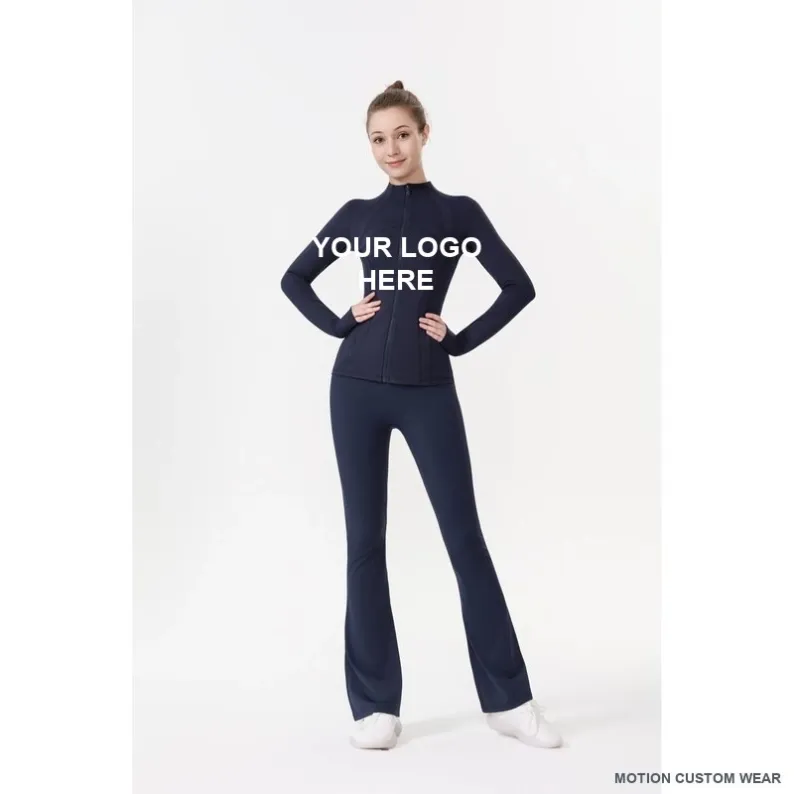
Method by fabric
Sublimation suits polyester and produces a print that becomes part of the fabric, which moves with it. It is the most durable option on activewear and the most colour-flexible.
Heat transfer suits small marks and full-colour detail, and behaves well if the application is correct for the fabric.
Embroidery on activewear needs care. A dense embroidery on a stretch panel restricts movement and can pucker. A small mark on a stable area works.
Screen print on stretch panels is the method that fails most visibly, because plastisol does not stretch with the fabric.
Method · On stretch fabric · Constraint
Sublimation · Best · Polyester only
Heat transfer · Good for small marks · Application temperature and fabric
Embroidery · Small marks only · Must avoid high-stretch panels
Screen print · Poor · Cracks at the edges
Silicone or high-density · Limited · Rigid, restricts movement
✔ Sublimation is the most durable decoration on stretch polyester True The print becomes part of the fabric rather than sitting on it, so it moves with the garment instead of cracking at the edges.
✘ A large screen print is suitable for stretch activewear False Plastisol does not stretch with the fabric, so a large print cracks at the edges on the first stretch. Small heat transfer marks perform better.
What has to be confirmed before bulk?
Fabric specification with recovery and opacity, the size chart, the decoration method, and the wash performance.
Confirm four things before an activewear run: the fabric's stretch and recovery specification, its opacity at the actual colour, the size chart measured on a body rather than flat, and the wash performance including colour fastness and shrinkage. Activewear is washed more often than any other garment in the range.
The size chart is the item that needs the most care. Activewear fits close to the body, so a centimetre of difference is more visible than on a loose garment. Measure on a body, not flat.
Wash performance matters because activewear is washed after every use. Colour fastness and shrinkage figures should come from a test that matches how the garment will actually be cleaned.
Specification · What to confirm · Why it matters
Stretch and recovery · Percentage recovery after stretch · Bagging at knee and seat
Opacity · Tested at the actual colour · Sheer panels are a return
Size chart · Measured on body · Close fit exposes small errors
Colour fastness · Grade after repeated washes · Fading in a wash-heavy garment
Shrinkage · Maximum percent per direction · Fit drifts after first washes
✔ Activewear should be tested in motion, not standing still True Stretch garments change shape, opacity and seam loading as soon as the wearer moves. A standing fit check does not reveal any of those failures.
✘ A large screen print is a suitable decoration for stretch activewear False Plastisol does not stretch with the fabric, so a large print cracks at the edges on the first stretch. Sublimation or small heat transfer marks perform better.
Conclusion
Specify recovery and opacity before the cut. Test the sample in motion. Choose set or separates from the commercial model. Decorate with methods that flex.
Motion coordinates custom apparel projects with selected production partners, from brief and sample confirmation through production follow-up and delivery coordination.