Oct 19, 2026
Refreshing Uniforms for a Restaurant or Hotel?
Hospitality uniforms are chosen for the commercial wash cycle, not the hanger: colour fastness and shrinkage first, then a role-based size file and a wave rollout.
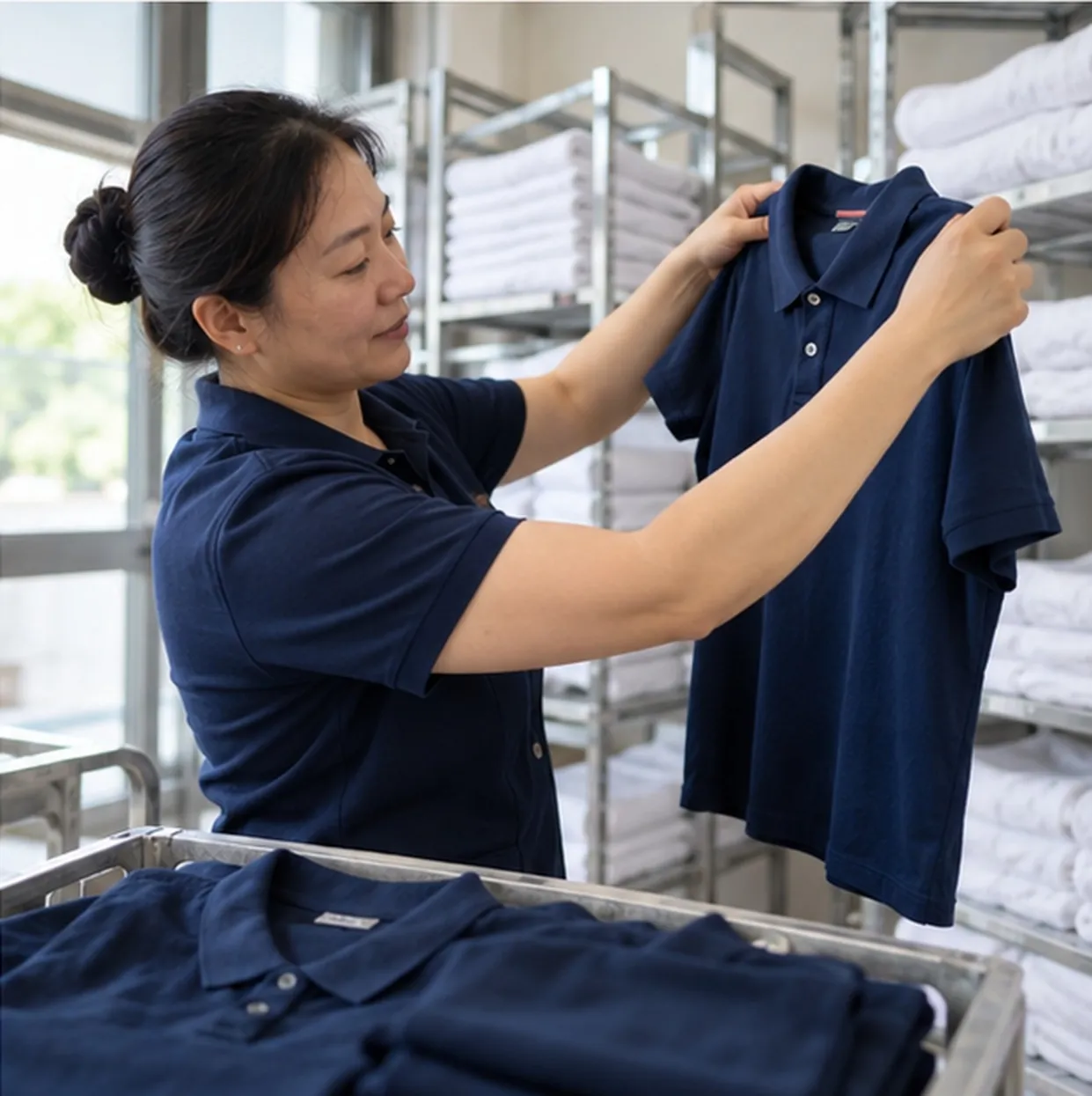
Hospitality uniforms are worn harder than office uniforms and replaced more often, which changes what you should buy.
Refreshing hospitality uniforms means choosing fabric for commercial laundering and stain exposure before choosing colour, planning for turnover rather than headcount, and rolling out in waves by outlet so service never stops. The garment has to survive the wash cycle, not just the shift.
Below: why hospitality uniforms fail faster, how to plan a size file when staff turnover, which fabrics survive a commercial laundry, how to roll out without closing, and what belongs in the uniform policy.
Why do hospitality uniforms fail faster than office uniforms?
Because the wash cycle is harsher, the garment is worn longer, and the same shirt is asked to look presentable at hour ten.
Hospitality uniforms fail faster because they face commercial laundering, food and oil exposure, and repeated wear between washes. A garment chosen for appearance alone loses shape, colour and stain resistance within months, so the refresh cycle is set by the wash, not by the season.
Four forces, one garment
Four forces act on the garment at once. Heat and chemistry from the laundry shorten fibre life. Oil and protein stains bond during a hot wash if they were not treated first. Continuous wear in one garment concentrates abrasion at cuffs, collars and seat. And the staff member has no second shirt to rotate, so the garment never rests.
This is why a shirt that performs well in an office programme disappoints in a restaurant. The office shirt is worn twice a week and washed at home. The restaurant shirt is worn five times a week and washed commercially.
Force · Effect on the garment · What to specify for
Commercial laundering · Heat, chemistry and mechanical action · Colour fastness and shrinkage after repeated cycles
Food and oil exposure · Staining, especially on light colours · Stain release finish, darker tones on high-exposure roles
Continuous wear · Abrasion at cuffs, collar, seat · Fabric weight and construction at stress points
No rotation · Fabric never recovers · Two sets per person, not one
✔ Colour fastness after repeated commercial washing is the specification that decides uniform life True Heat, chemistry and mechanical action are what shorten garment life. A grade measured under the real wash conditions is the only reliable predictor.
✘ A uniform that looks good on the hanger will perform well in service False Appearance on a hanger says nothing about oil exposure, collar structure or how the fabric behaves after twenty commercial washes.
How do you build a size file when staff turnover?
Build it as a standing roster with sizes attached, not as a project list that expires.
Hospitality size files have to survive turnover, so the record belongs to the role, not only to the person. Keep a role-based size reference, keep two garments per person, and place top-up orders on a fixed rhythm so a new hire is not waiting four weeks for a shirt.
A restaurant with thirty staff and forty percent annual turnover replaces about a dozen people a year. Those replacements are not a project. They are a steady trickle that a project-based ordering process handles badly.
Two structures make it workable. The first is a role-based size reference, which records the size distribution for each role rather than only for each named person. When a new hire starts, the manager assigns from the role reference and confirms with a trial shirt if the fit is unclear. The second is a fixed top-up rhythm, monthly or quarterly, so replacements accumulate into one order rather than being ordered one at a time.
Minimums shape this. A top-up order is subject to the same minimum as the first order, per design and per print colour. A monthly top-up of four shirts costs more per unit than a quarterly top-up of twelve.
Approach · How it handles a new hire · Cost per unit
Named list only · Rebuild the list and order one shirt · Highest
Role-based reference · Assign from the reference, confirm fit · Lower
Role reference plus quarterly top-up · Assign and wait for the next batch · Lowest
Two garments per person
One shirt per person is the most common hospitality mistake. A garment washed daily and worn daily has no recovery time, and it fails at the collar and cuffs first.
Two sets per person doubles the order but roughly halves the replacement rate. For front-of-house roles the second set is close to essential. For back-of-house it depends on the laundry turnaround.
✔ A role-based size reference handles turnover better than a named list alone True Named lists expire with the people on them. A role reference lets a manager assign a size to a new hire without rebuilding the order.
✘ Ordering single replacement shirts as people leave keeps the programme efficient False Single shirts carry the full setup cost. Batching replacements into a quarterly top-up lowers the cost per unit.
Which fabrics survive a commercial laundry?
The ones specified for colour fastness and shrinkage, not the ones that feel best on the hanger.
Specify fabric by the properties the laundry tests: colour fastness after repeated wash cycles, shrinkage after the same cycles, and pill resistance. Weight matters too, because a light knit loses shape faster than a mid-weight one under commercial handling.
Three specifications belong in the order. Colour fastness, expressed as a minimum grade for wash and for light. Shrinkage, expressed as a maximum percentage for length and width after a stated number of cycles. Pilling, expressed as a minimum grade for the fabric type.
The wash cycles matter as much as the grades. A garment tested after five domestic washes has not been tested for a commercial laundry. Ask what the test conditions were and whether they match how the garment will actually be cleaned.
Weight is the practical lever. A mid-weight piqué polo holds its collar and resists see-through better than a light single jersey, and it survives commercial pressing with less shine. The trade is warmth, which matters in a hot kitchen and matters less in an air-conditioned dining room.
Property · What to specify · Why it fails without it
Colour fastness · Minimum grade for wash and light · Fading and cross staining in the wash
Shrinkage · Maximum percent, length and width · Fit drifts after the first month
Pilling · Minimum grade · Surface looks worn before it is worn
Weight · Mid-weight for front of house · Light knits lose shape and collar structure
Colour choice is a laundry decision
White and light colours show every oil mark, and they are the hardest to keep looking clean through repeated commercial washing. Darker tones hide staining but show fading and shine.
The usual compromise is a darker tone for back-of-house and kitchen roles, and a mid or light tone for front of house where the uniform is part of the presentation. Whichever is chosen, the colour fastness grade is what keeps it looking the same in month six.
✔ A garment tested after five domestic washes is proven for hospitality use False Commercial laundering uses more heat, chemistry and mechanical action. Fastness and shrinkage figures have to come from a test that matches the real wash.
✘ Darker colours solve staining problems in hospitality uniforms False Dark tones hide some stains but show fading and shine sooner. Colour fastness grade, not colour choice, is what decides how the garment looks in month six.
How do you roll out without closing service?
By outlet and by shift, in waves, with the old uniform still in service until the new one is confirmed.
Roll out a uniform refresh in waves by outlet or by shift, keeping the old uniform in service until the new one is confirmed on real staff. A single-day switch across every site is the fastest way to discover a fit problem with no fallback.

The first wave should be the smallest unit you can isolate: one outlet, one shift, or one team. Those people wear the new garment for a week or two and report the problems while the rest of the estate is still on the old one.
What the first wave exposes
Three problems surface in that first wave, and each is cheap to fix before mass delivery. The collar sits differently than expected, the size runs differently from the old supplier, and the colour reads differently under the venue's lighting. Any of them is expensive to discover after the whole estate has switched.
Logistics belong in the plan. Bulk delivery to one central address is simplest if there is storage. Delivery per outlet removes the redistribution work but requires an address and a contact for each. Whichever you choose, the carton should be labelled per outlet and per size, because a mixed carton at a venue with no storage is a problem.
Rollout model · Best for · Risk
Single wave, all sites · Small estates with one location · No fallback if fit is wrong
Wave by outlet · Multi-site estates · Longer total timeline
Wave by shift · Single venue with continuous service · Two uniforms visible at once
Wave by role · Mixed front and back of house · Front and back look different during transition
✔ A first wave on one outlet or shift catches fit problems while the old uniform is still in service True The first wave exists to discover problems cheaply. Running it across the whole estate means there is no fallback if the fit is wrong.
✘ Delivering all uniforms to one central address is always the simplest option False Central delivery only works if there is storage and someone to redistribute. Without both, per-outlet delivery with correct carton labelling is simpler.
What belongs in the uniform policy?
The policy is what makes the uniform last, and it is usually written after the first refresh rather than before.
A uniform policy should state how many sets each role receives, who owns the garment, how it is laundered, when it is replaced, and what happens on leaving. Without replacement rules, garments are worn past the point of presentation and the refresh cycle is driven by complaints instead of schedule.
Five items cover most of it. The number of sets per role. Whether the garment is issued or deducted. The laundering route, which decides the fabric specification. The replacement trigger, whether that is a set interval or a condition. And the return or retention rule when someone leaves.
The replacement trigger is the item that saves money. A garment replaced when it looks worn is replaced at the right time. A garment replaced only when it falls apart is being worn in front of guests long after it stopped representing the brand.
✔ Two sets per person usually costs less over a year than one set replaced more often True A single garment washed daily has no recovery time and fails at the collar and cuffs first. Rotation extends garment life more than the extra set costs.
✘ A garment should be replaced only when it falls apart False A uniform worn past the point of presentation costs more in brand damage than a scheduled replacement. The policy needs a condition trigger as well as an interval, or the refresh cycle is driven by complaints.
Conclusion
Choose fabric for the wash, not the hanger. Build a role-based size file. Roll out in waves. Write the replacement rule into the policy.
Motion coordinates custom apparel projects with selected production partners, from brief and sample confirmation through production follow-up and delivery coordination.