Oct 19, 2026
Outfitting a Wedding Party in Custom Suits?
Outfitting a wedding party means collecting measurements from people in different cities, locking one fabric and colour, ordering the whole party in one batch, and running the timeline backwards.
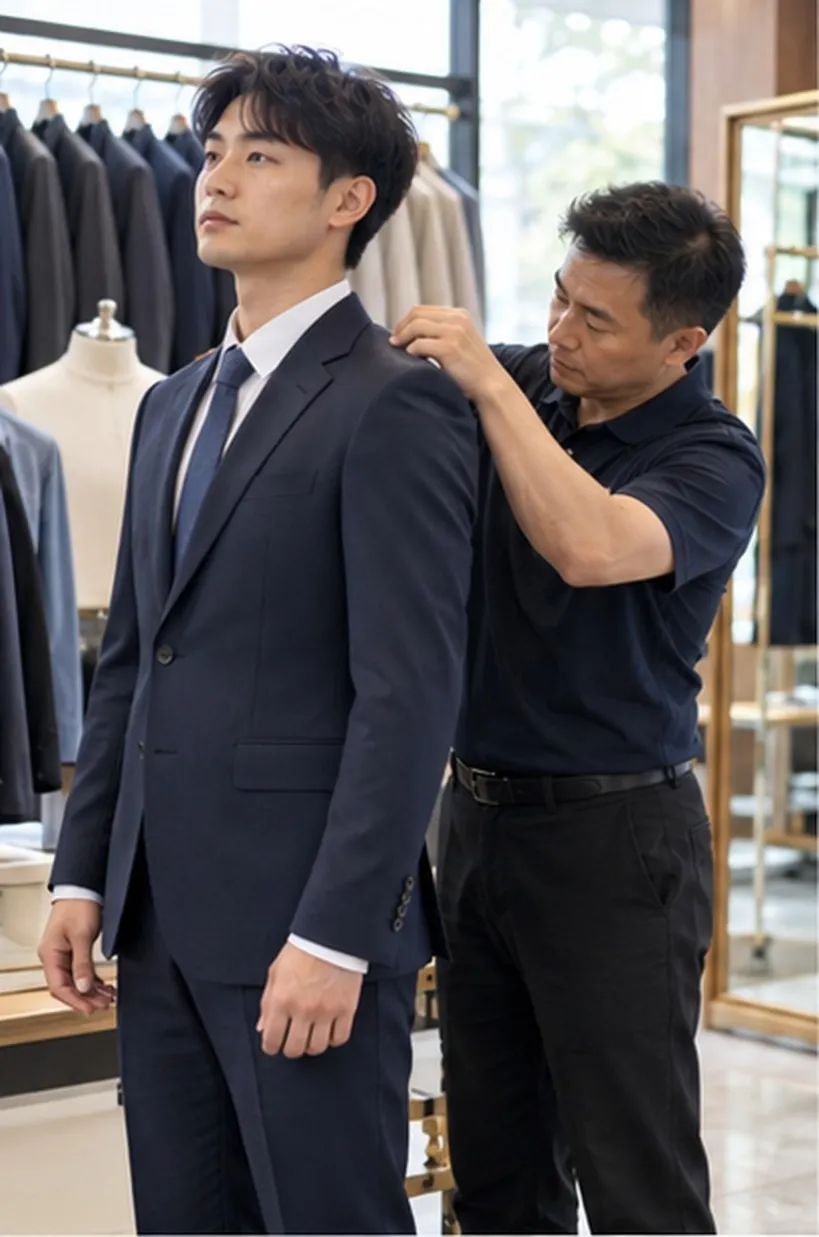
The party is a project, not a purchase
A wedding party is the hardest sizing job in menswear: six to ten people, none of them measured, one fixed date, and no second chance.
Outfitting a wedding party in custom suits means collecting measurements from people in different cities, choosing one fabric and colour everyone agrees to wear, ordering the whole party in one batch so the cloth comes from the same dye lot, and locking the timeline backwards from the wedding date. Order the party together, not person by person.
Below: why wedding parties go wrong, how to get measurements without gathering everyone, what to decide before anyone is measured, how the timeline actually runs, and what to do about the one groomsman who orders late.
Why does a wedding party order go wrong?
Three failures, one root cause
Almost never on tailoring. It goes wrong on coordination and on time.
Wedding party suits fail on three things: measurements taken from people who are not present, colours that drifted between separate orders, and a timeline that assumed everyone would reply on schedule. Each is avoidable with one batch order and one measured chart.
The couple is planning a wedding, not a production run. The best man is in another city. One groomsman is travelling. Someone will gain or lose weight between measuring and the wedding.
Three structural problems follow. First, sizes arrive from six different sources in six different formats, and nobody can confirm they are comparable. Second, if each person orders separately the cloth comes from different dye lots, and two navy suits read as two different navies in photographs. Third, the date cannot move, so every late reply eats the buffer.
Failure · What it looks like · What prevents it
Scattered measuring · Sizes from six cities, no common chart · One measured chart, one collector
Separate orders · Two navies in the same photograph · One batch, one dye lot
Late reply · One suit arrives after the wedding · Hard cutoff plus buffer
✔ Ordering the whole wedding party in one batch protects the colour across every suit True Separate orders draw from different dye lots, and two navies side by side in a photograph are obvious. A batch order keeps the party on one cloth run.
✘ A wedding party can be ordered person by person as replies arrive False Person-by-person ordering multiplies dye lot risk and breaks the timeline. One batch with one cutoff keeps colour and delivery together.
How do you get measurements from people in different cities?
You publish a chart, name one collector, and give everyone the same deadline.
Collect wedding party measurements by sending one measured garment chart with one form and one cutoff date, asking each person to measure a jacket and trouser they already own rather than their body. Body measurements taken at home are unreliable; garment measurements checked against a known jacket are not.
Why home measuring goes wrong
Self-measuring is where most of the error enters. People measure their chest with their arms down, or their waistband over trousers, and the numbers do not correspond to a garment. Measuring an existing jacket flat on a bed produces numbers a tailor can use.
Two steps make it work. Publish the chart showing chest, shoulder, sleeve and waist, measured flat on a garment. Then ask each person to check one garment they own and already like the fit of, and report the size that garment is. The tailor can reconcile the two.
For the party, one person should own the collection: usually the best man or a family member. Six people reporting to six people produces six versions of the truth.
Method · Reliability · When to use
Body measurements taken at home · Low to moderate · Only when nothing else is possible
Garment measurements from an owned suit · Moderate to high · Default for a remote party
In-person fitting with a tailor · Highest · Groom and anyone local
Trial suit before the wedding · Highest but slowest · Small parties with time
✔ Measuring a suit the person already owns is more reliable than measuring their body at home True A garment measurement is a fixed reference a tailor can use. Home body measurements vary with posture, method and who holds the tape.
✘ Every member of the party should measure themselves to save time False Self-measuring produces six versions of the truth in six formats. One published chart and one collector produces comparable numbers.
What should be decided before anyone is measured?
Fabric, colour, cut and the level of customisation, in that order. Sizes come last.
Decide fabric, colourway and cut style before collecting a single measurement. Changing fabric or colour after sizes are taken restarts the order, and changing the cut changes every measurement. The couple should lock three things in writing: cloth, colour and silhouette.
Cloth decides the season, and the price
Fabric choice drives the price and the season. A four-season wool travels better than a linen, which creases but breathes in heat. The cloth also decides how the colour reads under different light.
Colour is the decision that breaks parties. Two people discussing "navy" are often picturing different navies. The fix is physical: approve one cloth swatch and keep it, so every later conversation refers to the same piece of fabric.
Cut is the third decision and the one people change their minds about. Slim, classic and relaxed produce different measurements from the same body. Locking the silhouette before measuring avoids re-measuring the whole party.
Decision · Lock when · Cost of changing later
Fabric and weight · Before measuring · Resets the quote and the timeline
Colourway · Before measuring · Risk of dye lot mismatch between orders
Cut and silhouette · Before measuring · Every measurement has to be retaken
Details (lapel, vents, lining) · Before the sample · Minor per person, but adds up
✔ Fabric and colour should be locked before a single measurement is taken True Changing cloth or colour after sizing restarts the order and reopens the dye lot question. Changing the cut invalidates every measurement.
✘ Any shade of navy will read the same in wedding photographs False Two navies from different cloths or lots read as two colours side by side. One approved swatch keeps the party on the same reference.
How does the timeline actually run?
Backwards from the wedding date, with one buffer for the person who replies last.
Run the timeline backwards from the wedding: allow 5 to 7 business days for the pre-production sample, a production target of 15 days for selected runs, plus freight and one alteration window at the destination. Add two weeks of buffer for late measurements, and publish the last acceptable date for a late addition.
Why the sample is not optional
The sample is the step couples skip and regret. One physical sample confirms the cloth, the shoulder line and the lapel width on a real garment. A digital mockup confirms none of those things.
The alteration window matters more for a wedding than for a uniform programme. Bodies change, and a suit can be adjusted at the destination if there is time. If there is no time, the adjustment becomes an emergency.
Freight deserves its own line. Destination weddings need the suits delivered to the destination, not to the couple's home, and the delivery date needs to be the arrival date, not the shipping date.
Stage · Duration · What it protects
Cloth and colour lock · One decision meeting · Everything downstream
Measurement collection · Two to three weeks · The production slot
Pre-production sample · 5 to 7 business days · Fit and cloth approval
Production · 15 days for selected runs, confirmed in writing · The freight window
Freight · Varies by lane · The alteration window
Alterations at destination · One to two weeks · The wedding day
What about the groomsman who orders late?
He exists in almost every party. The workable answer is a batch addition rather than a separate order.
Order one or two spare suits in the most common size in the party, and offer a late addition slot at the measurement cutoff. If he misses that, he wears the spare and has it altered.
✔ A wedding timeline should be built backwards from the date, not forwards from approval True The date cannot move, so everything else has to fit inside it. Working backwards reveals the real measurement deadline.
✘ A digital mockup is enough to approve a wedding suit False A mockup confirms the design, not the shoulder line, the lapel width or how the cloth behaves. Those need a physical sample.
What do the accessories need?
Ties, pocket squares and any waistcoat should come from the same cloth source as the suits.
Order ties, pocket squares and waistcoats at the same time as the suits, from the same cloth or a matched reference, so the accessory colour reads as part of the same outfit. Accessories ordered separately are the most common source of a visible shade mismatch in wedding photographs.
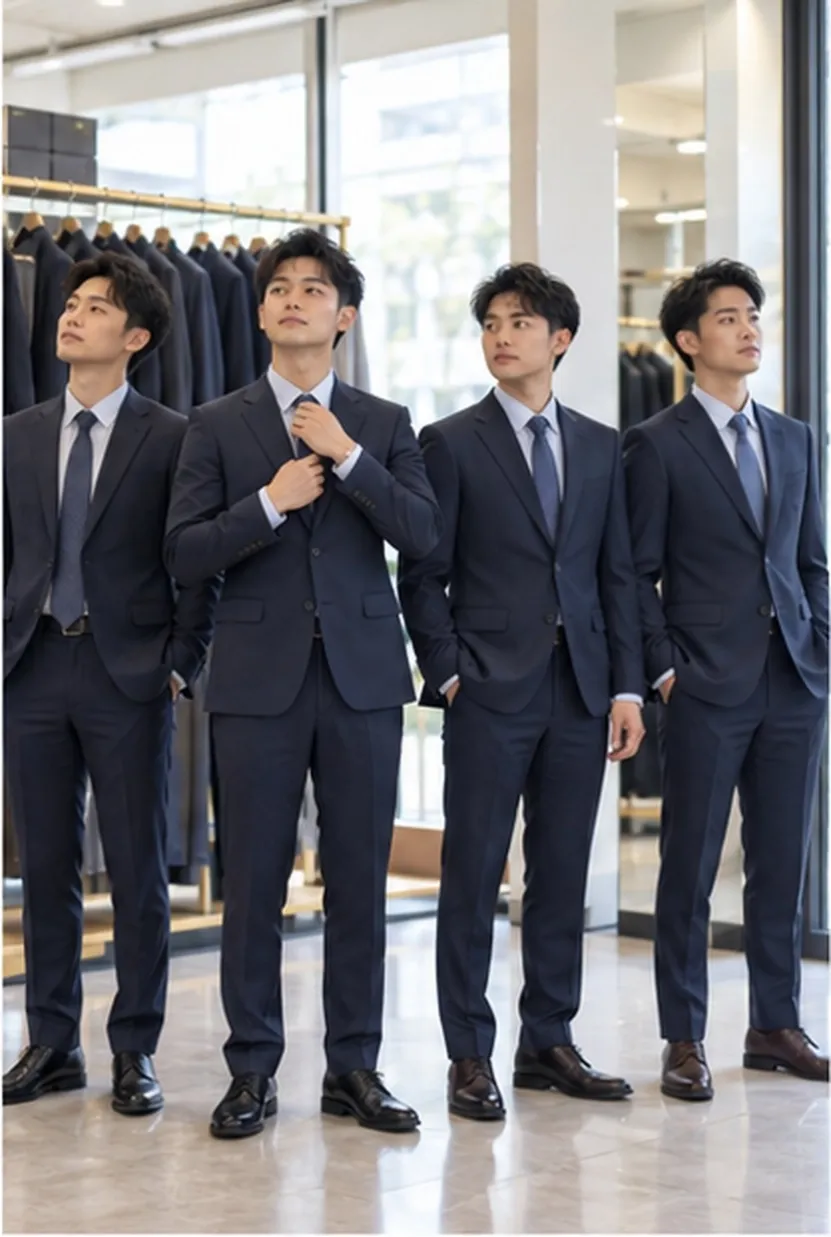
Match the accessory to the cloth
Accessories are cheap per unit and expensive to re-order, because a second run of tie fabric rarely matches. Ordering them in the same batch removes the risk entirely.
For mixed parties, the accessories are also where individual expression fits. Same suit, different tie is a common and workable variation.
✔ Ties and pocket squares should be ordered with the suits, not later True A second run of accessory fabric rarely matches the first. Ordering together keeps the accessory colour on the same reference.
✘ Accessories are where a wedding party should save money False Accessories are cheap per unit and expensive to re-order, because matching cloth later is difficult. The saving is small and the mismatch is visible.
What should the couple keep afterwards?
The specification and the measurements, because a reorder or a second event often follows.
Keep the approved cloth reference, the cut specification, the size chart and each person's measurements after the wedding. The same party often needs a second suit for another event, and a matched jacket or trouser a year later is only possible if the spec still exists.
The record is short: cloth reference, colour, cut, and the measurement list. It is the difference between a matching second order and a near miss.
✔ Keeping the cloth reference and the measurement list makes a second suit possible True A matching jacket or trouser a year later depends on the original spec still existing. Without it, the second order is a near miss.
✘ The specification can be discarded once the wedding is over False The same party often needs a second suit for another event. The spec is what makes it match rather than merely resemble.
Conclusion
Lock cloth, colour and cut first. Collect garment measurements, not bodies. Order one batch. Run the timeline backwards and keep two weeks of buffer.
Motion coordinates custom apparel projects with selected production partners, from brief and sample confirmation through production follow-up and delivery coordination.