Oct 19, 2026
Ordering Staff and Attendee Apparel for a Conference?
Conference apparel splits into two products: staff shirts that must arrive before setup day, and attendee items ordered to a forecast rather than a roster.
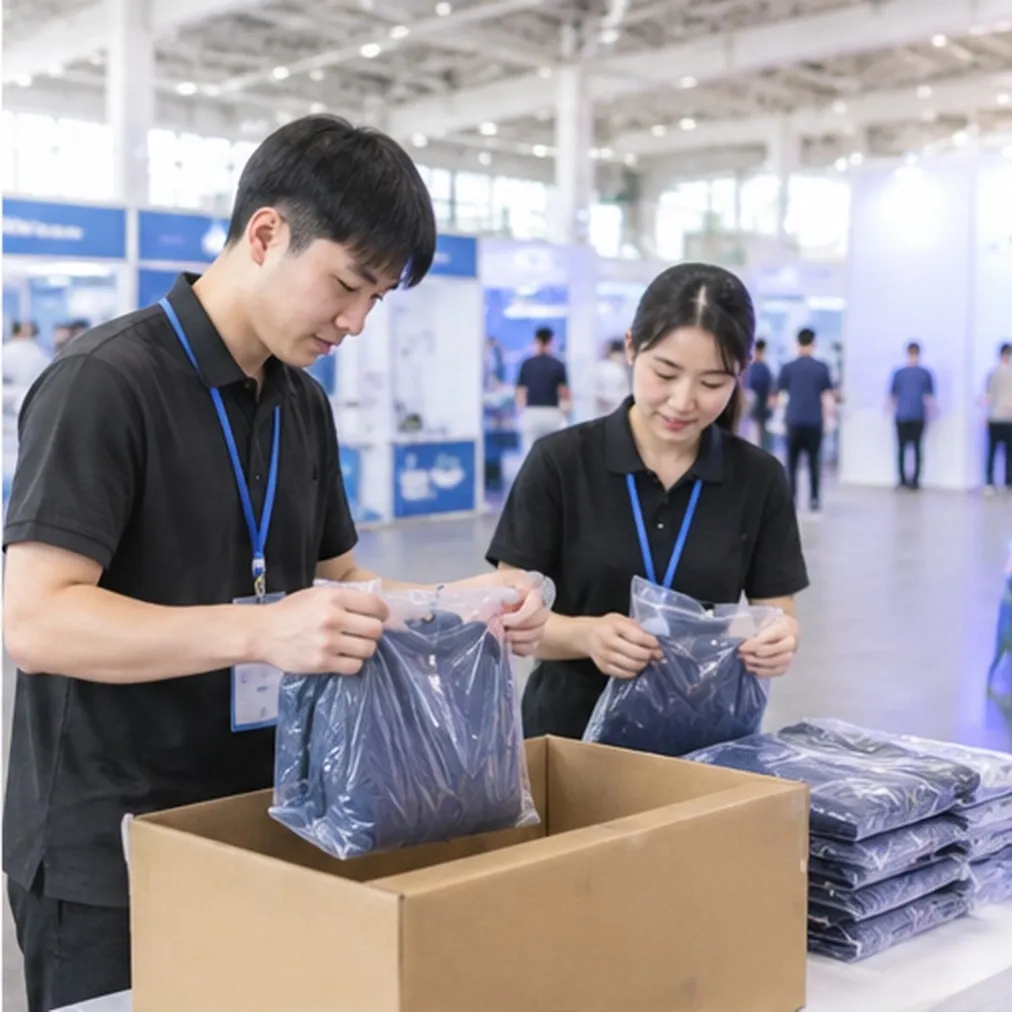
The shirts are the last line on the marketing checklist and the first thing that cannot be fixed once the show opens.
Ordering conference apparel splits into two products with two different rules: staff shirts that must arrive before setup day and attendee items that must be ordered to a forecast. Staff orders are built from a roster with sizes confirmed; attendee orders are built from a percentage of registrations, ordered early, and shipped in one delivery.
Below: why event apparel arrives late, how many staff shirts you actually need, what changes for attendee items, how to size people you have never met, and the cutoff dates that decide whether the order works.
Why does conference apparel arrive late?
Because the order starts when the design is approved, and the design is usually approved last.
Conference apparel arrives late because the approval chain runs through marketing, brand and legal while the event date does not move. The order needs a fixed artwork deadline that sits weeks before the event, not a target date for delivery, and every internal approval has to fit inside it.
An event date is fixed by contracts and venue bookings. Apparel is one of dozens of items and usually the last to be briefed. When it starts late, the options shrink to air freight and an order placed without a sample.
The fix is procedural rather than commercial. Work backwards from the date the garments must be in hand, which is usually the day before setup, and subtract production, freight and one approval round. What remains is the artwork deadline, and it is usually further in the past than the team expects.
Milestone · What it consumes · What it protects
Artwork deadline · Design and brand approval · The sample round
Sample approval · 5 to 7 business days · The bulk run
Production · 15 days for selected runs, confirmed in writing · The freight window
Freight and clearance · Lanes and destination · The in-hand date
Buffer · Setup day · A late carton
How many staff shirts do you actually need?
Count the people who will be identified as staff, then add a spare set.
Staff shirt quantity comes from a roster, not a headcount estimate: count confirmed staff, add photographers and contractors who need to look like staff, and add a small spare set in the middle sizes. Staff apparel works as identification, so an undercount shows as people in plain clothes on the floor.
Count the floor, not the org chart
Two groups are usually missed. Contractors and agency staff who work the floor often need to be visually identifiable, and they are not on the internal roster. Photographers and videographers may need a specific colour to stand apart from the team.
The spare set covers the practical failures: a shirt that does not fit, a shirt damaged during setup, and a person added the week before. Spares belong in the middle sizes because that is where a replacement usually lands.
For staff, the garment is functional. A polo or a tee with a small chest logo is the usual choice, and it needs to survive a twelve-hour day and a wash. Fabric weight matters more than decoration detail at this level.
Staff group · Needs apparel · Sizing source
Core team · Yes · Internal roster
Contractors on the floor · Usually · Roster from the agency
Photographers and media · Sometimes, in a distinct colour · Direct contact
Volunteers · Sometimes · Sign-up form
Speakers · Often a gift, not a uniform · Optional field on the brief
✔ Contractors and agency staff usually need to look like staff on the floor True They are visible to attendees and are often mistaken for staff. If they are not on the roster, the order is short by however many of them work the floor.
✘ Staff spare shirts should be spread evenly across all sizes False Replacements land in the middle sizes. Evenly spread spares leave extremes that are never issued while the middle runs out.
What changes for attendee items?
Attendee apparel is a forecast, not a roster, so the order is built on a percentage and shipped before the final registration count is known.
Attendee items are ordered to a percentage of expected registrations, not to a confirmed list, and they are shipped in one delivery before the event. Order below the registration forecast rather than above it, because surplus attendee apparel has no second use.
The percentage depends on the event type. A technical conference with a paid ticket and a professional audience tends to have higher take-up than a free community event. The honest approach is to use last year's number if the event repeats, and to order conservatively for a first edition.
Attendee items also carry a decision the staff order does not: whether the garment is a giveaway, a paid add-on, or a tier benefit. A giveaway needs volume and a low unit cost. A paid add-on can carry a better garment, because the attendee chose it.
Sizing for attendees is the hardest part. You cannot collect a size from someone who has not registered yet. The usual answer is to collect the size at registration as an optional field, order to the collected distribution, and hold a small buffer in the middle.
Attendee model · Order basis · Sizing
Free giveaway · Percentage of registrations, ordered early · Collected at registration
Paid add-on · Confirmed purchases plus a small buffer · Collected at purchase
Tier benefit · Percentage of that tier · Collected at registration
Speaker or VIP gift · Named list · Confirmed individually
✔ Attendee apparel is a forecast and should be ordered below the registration figure True The final count is unknown when the order is placed. Surplus attendee garments have no second use, so ordering below the forecast is the cheaper error.
✘ Attendee garments can be sized after the event is over False Sizing has to be collected at registration or purchase. Once the order is placed, the size mix is fixed.
How do you size people you have never met?
Use a measured garment chart, collect sizes where you can, and concentrate the buffer in the middle.
Size people you have never met by publishing the supplier's measured garment chart alongside registration, collecting size as an optional field, and ordering the resulting distribution rather than a standard curve. Where no size is given, assign the middle size rather than a guess at the extremes.

The measured chart is the single most useful asset here. A body measurement guide asks the registrant to know their own measurements. A garment chart showing chest width and body length flat lets someone compare against a shirt they own.
Design the registration field to make the default easy. If size is optional and unlabelled, most people skip it. If it is a dropdown with the chart linked and a "not sure" option, most people answer.
The "not sure" group is where the middle-size assumption applies. Assigning them a middle size keeps the order coherent. Assigning them the largest size inflates the count of extremes that nobody collects.
Watch the decoration on both products
Staff and attendee garments usually carry different decoration. Staff shirts carry the logo small and consistent. Attendee items may carry a design, a year, or a sponsor block.
Decoration drives the setup cost, not the garment. Each colour and each position carries its own setup, which is why a single-colour staff logo is cheaper per unit than a multi-colour attendee design. It also drives the sample: a design with several colours needs a physical sample more than a single-colour logo does.
✔ Publishing the supplier's measured garment chart lifts the share of registrants who give a size True A garment chart lets someone compare against a shirt they own. A body measurement guide asks them to know their own measurements.
✘ Registrants who give no size should all receive the largest size False Assigning everyone to the largest size fills the order with extremes nobody collects. A middle-size default keeps the distribution coherent.
What cutoff dates should you plan around?
Three dates, three owners
Three dates decide the order: artwork approval, sample approval and the freight booking.
Plan around three cutoffs: the artwork deadline, which protects the sample round; the sample approval date, which releases production; and the freight booking date, which protects the in-hand date. Missing any one of them converts a sea freight order into an air freight order.
The artwork deadline is the one the event team controls, and it is usually the one that slips. Publishing it as a hard date, with the consequence stated, is more effective than a reminder.
The sample date matters even for a simple logo, because it is the only point where colour and placement are checked against a physical garment. A digital proof confirms position and scale; it does not confirm how the ink sits on the fabric.
Freight booking is the date that quietly decides the mode. Sea freight has a booking lead time as well as a transit time, and a late booking moves the shipment to air whether or not anyone approved the cost difference.
✔ A conference apparel order should be scheduled from the in-hand date backwards, not from the approval date forwards True The event date is fixed and everything else is variable. Working backwards reveals the real artwork deadline, which is usually earlier than planned.
✘ A digital proof is enough to release bulk production for event apparel False A digital proof confirms placement and scale in pixels. Colour on fabric, and how the decoration sits on the actual garment, need a physical sample.
Conclusion
Split staff and attendee orders. Work backwards from setup day. Publish the measured chart. Protect the three cutoffs.
Motion coordinates custom apparel projects with selected production partners, from brief and sample confirmation through production follow-up and delivery coordination.