Oct 3, 2026
Print Placement Tolerance: What's Acceptable on Bulk Orders
Agree print placement tolerance in centimetres before bulk starts: chest, back and sleeve positions, how off-centre counts as a defect, and what to check on the approval sample.
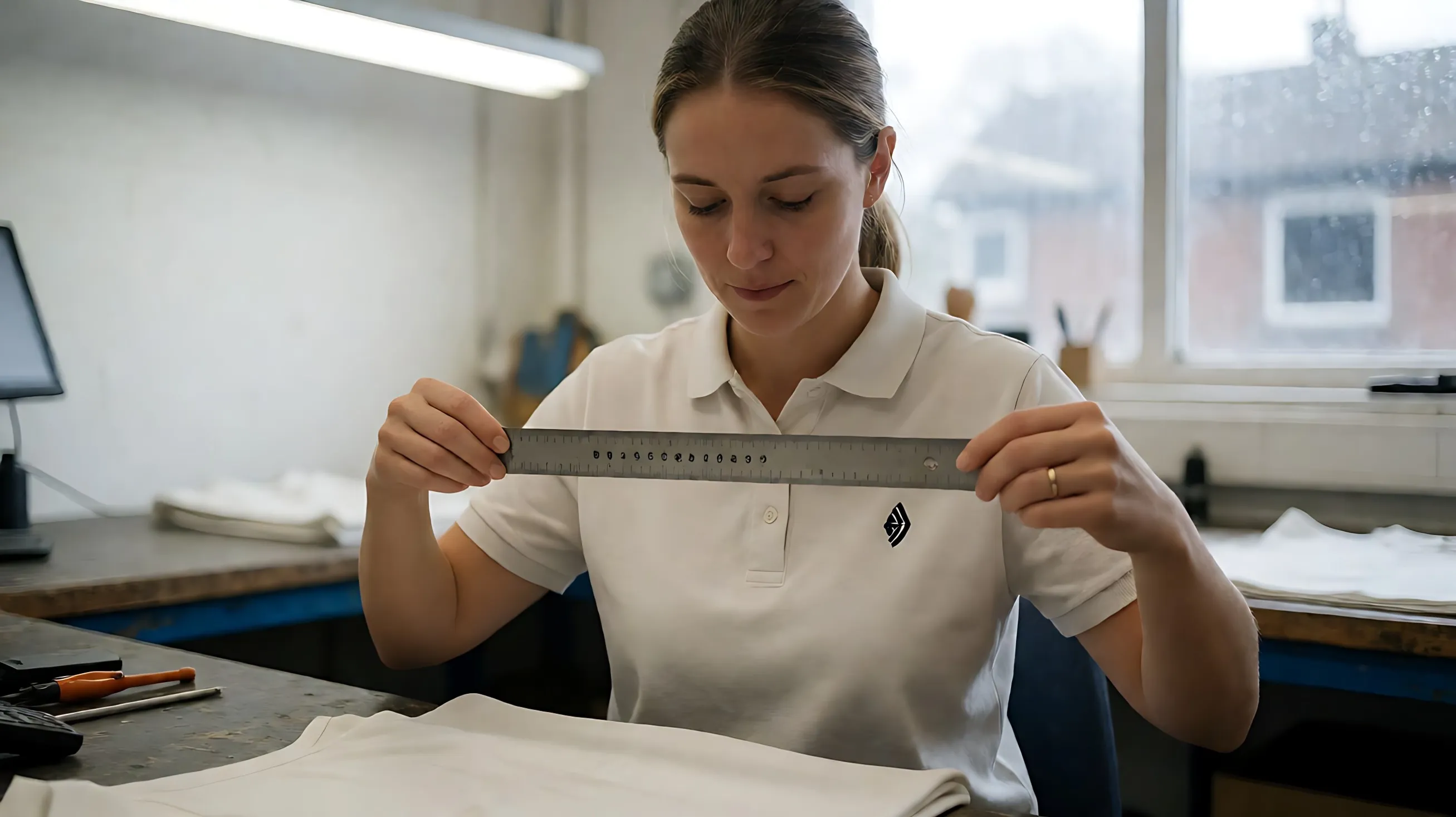
Short answer: whatever your PO says — which is why the PO must say it, in centimetres, from a named seam. Ask buyers which defect they refuse to forgive and placement wins: review aggregates on custom polos and tees show logo-placement complaints with no positive mentions at all. A crooked logo is the defect buyers photograph, post and never forget — visible from across the room. The uncomfortable part: placement is almost never specified, so both sides discover nobody ever defined what "centred" means.
Below: why placement drifts, where disputes concentrate, how to measure, the three-numbers rule, and what to check before releasing bulk.

Why does placement drift between the sample and the bulk run?
The sample was perfect; the bulk is two centimetres high; nobody touched the file. What changed:
• Different guides. Samples are printed on a jig set up by a senior operator; bulk runs use production-line templates — a template from a different size or a worn fixture offsets every piece.
• Different hands. Hand-guided setups — embroidery hooping, heat transfers — move with operator technique between shifts.
• Different garments. A placement measured on a size M sits differently on a 2XL: prints position from a seam, and seams vary across the size run.
• Speed. Nobody decides to ship crooked logos; the line just stops re-checking.
Take away: assume drift until proven otherwise. The control is not trust — it is a written tolerance, a physical check on the approval sample, and a mid-run pull from bulk.
Which placements cause the most disputes?
1. Left chest — the highest-volume position and the most disputed: it sits near a placket, a seam curve and a collar that all shift its visual frame; two centimetres off reads wrong immediately.
2. Centre back — large prints with no local reference; drift shows as distance from the collar.
3. Sleeve — small prints on a curved, seamed surface; "centred on the sleeve" is ambiguous enough to dispute from both sides.
4. Pocket- and hood-adjacent prints — pockets, zips and hood seams interrupt designs; a print that clears the pocket on a size S can collide on a 2XL.
Take away: for each placement, write the position *and* the reference feature — "left chest, [XX] cm down from the collar seam at the shoulder point, [XX] cm in from the placket edge". A position defined by distance from a named seam cannot be argued; "left chest" can.
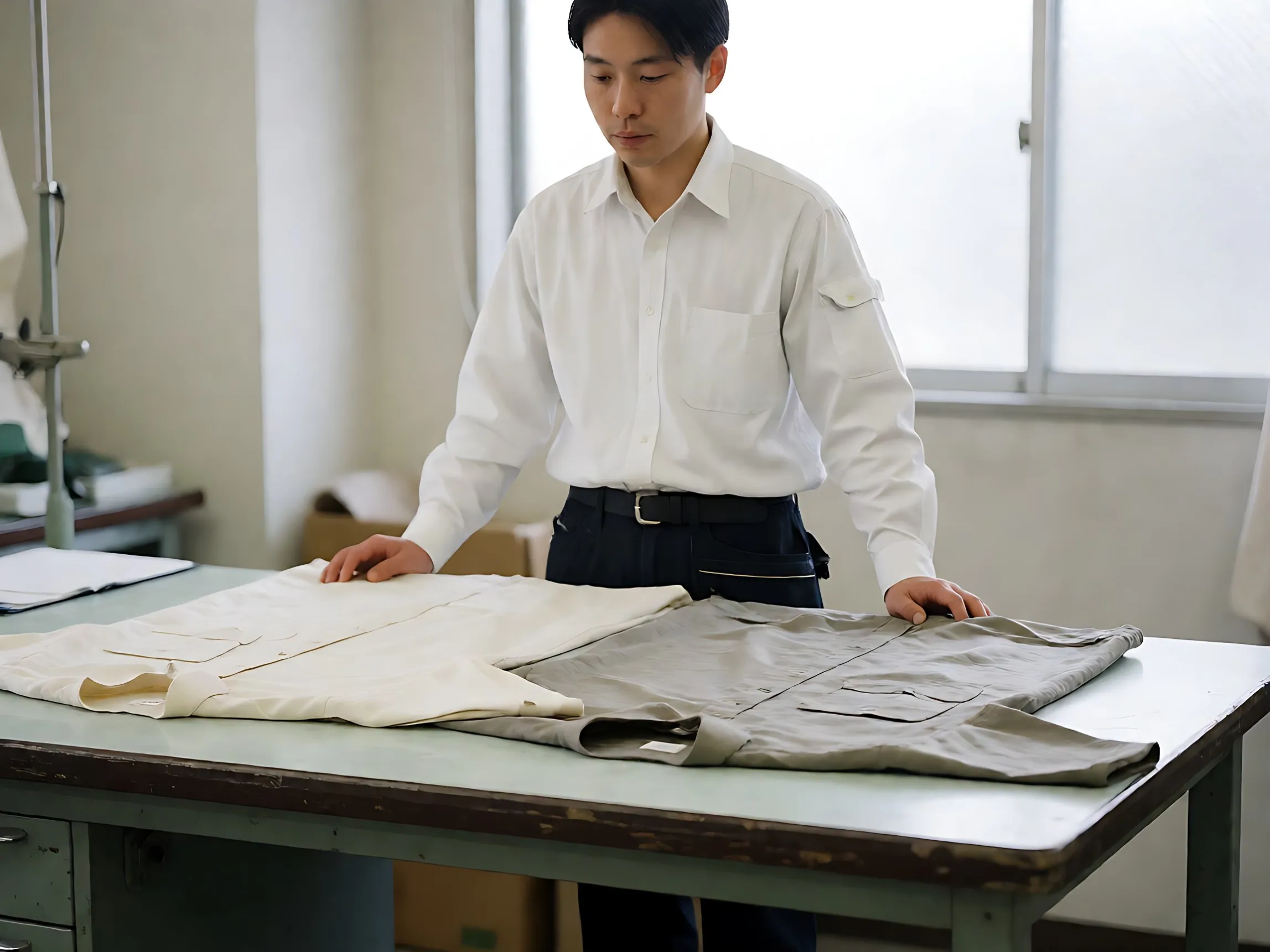
How is tolerance measured?
• Measure from stable landmarks — the collar seam at the shoulder's high point, the shoulder seam, the placket edge. These barely vary within a size.
• Never measure from the garment edge. Hems and side edges vary across the cutting table; a print perfect from the hem can read badly from the collar — and both sides will be right.
• Name the landmark per placement. "Left chest: from the collar seam, down [XX] cm, in [XX] cm." One line each; no interpretation left.
Take away: collar seam and shoulder seam are the defaults for chest and back; sleeves reference the shoulder seam and cuff. If a supplier measures from somewhere else, ask why — the answer is usually habit, not engineering.

Why is "centred" not a spec?
"Centred on the chest" is a wish. A tolerance is a number:
• A workable band for most placements is ±[XX] cm per axis, agreed in the PO and applied at inspection. Tighter bands are possible and priced — the cost lands in your unit price.
• Tolerance covers position, rotation and size. A print can sit dead-centre and be two degrees rotated, or perfectly placed and oversized. All three get numbers.
• The band governs the distribution. The inspection question is not "is this one shirt perfect" but "how many units sit outside the band" — above the agreed [XX], the lot is disputed.
True or false
✔ True: every print location needs three numbers — position from a named landmark, size in centimetres measured on the garment, and a tolerance band. Three numbers end the dispute class.
✘ False: fixing placement is enough. The most common half-specified order fixes placement and forgets size — the buyer receives a perfectly centred logo twice the intended size, and the dispute is unresolvable because only one of the two specs ever existed.
What do you check on the approval sample before releasing bulk?
The approval sample is the last cheap checkpoint — run it with a ruler, not an opinion:
1. Measure every placement against the spec, from the named landmarks, and record the numbers.
2. Photograph each position with a tape in frame. Photos with measurements become the reference both sides compare bulk against.
3. Check the size run, not one sample — confirm placement on the largest and smallest sizes; this is where pocket collisions show up.
4. Sign the sample and file it with the measured photos — the acceptance standard for bulk and the reference for every reorder.
Take away: no measurement, no release. Bulk approval given from a photo without measurements approves nothing in particular.

When placement is wrong: repair, reprint or credit?
• Inside the band — within spec, not a defect, even if you do not love it. This is why the band should be a number you can live with.
• Outside the band, limited share — units beyond tolerance are reprinted or credited at supplier cost, up to the agreed threshold.
• Systematic miss — every piece drifted the same way: a setup or template error; that is rework of the affected run, not a discount conversation.
• No spec — an opinion contest settled by leverage. This is the outcome the three-numbers rule exists to prevent.
Take away: write the remedy ladder into the PO beside the tolerance — measurement, threshold, rework or credit. The clause pattern from the
AQL terms
works word for word here.Frequently Asked Questions
How far off can a printed logo be before it counts as a defect?
Whatever your PO says — commonly a ±[XX] cm band per axis, applied to units rather than the lot. Beyond the band, affected pieces are reprinted or credited per the remedy ladder. Without a written band, "how far off" is settled by argument.
Why is the logo straight on some shirts and crooked on others?
Placement is set by templates, fixtures or hand-guiding, each of which varies across a run. A mid-run pull from bulk shows the real distribution; the sample alone cannot.
Should print placement be measured from the collar or the shoulder seam?
From a named, stable landmark — collar seam at the shoulder point for chest and back, shoulder seam for sleeves. The landmark matters less than naming it.
Does the same tolerance apply to sleeves, hats and pockets?
No — curved, seamed and small surfaces need their own bands and reference points, usually wider than flat chest placements. Write each placement as its own line.
Can I reject a whole order over placement?
Only if the failure is systematic — every piece outside the band points to a setup error, and the remedy ladder applies. Scattered misses inside the agreed threshold are handled piece by piece.
How do I photograph a placement problem so a claim is accepted?
Tape measure in frame, measured from the named landmark, next to the signed approval sample. Claims are accepted on numbers that match the spec — a crooked-hanger photo proves mood, not deviation.
Is a placement spec included in the quote, or do I have to ask?
Ask. Placement specs are written per order into the PO appendix. If a quote arrives without one, request it before production — adding the spec after bulk starts is the most expensive way to buy it.
Approving placement on a live programme?
Request a Quote
— placement, size and tolerance are written into the PO appendix per order. Or review the sampling checklist
for the full approval chain, and the teams and clubs range
for jersey programmes.FACTS