Oct 3, 2026
Digital Mockup or Pre-Production Sample: What Does Your Order Need?
A mockup confirms placement, scale and spelling in hours; a physical sample confirms colour on fabric, hand feel and stitch behaviour. Route your approval by risk, not habit.
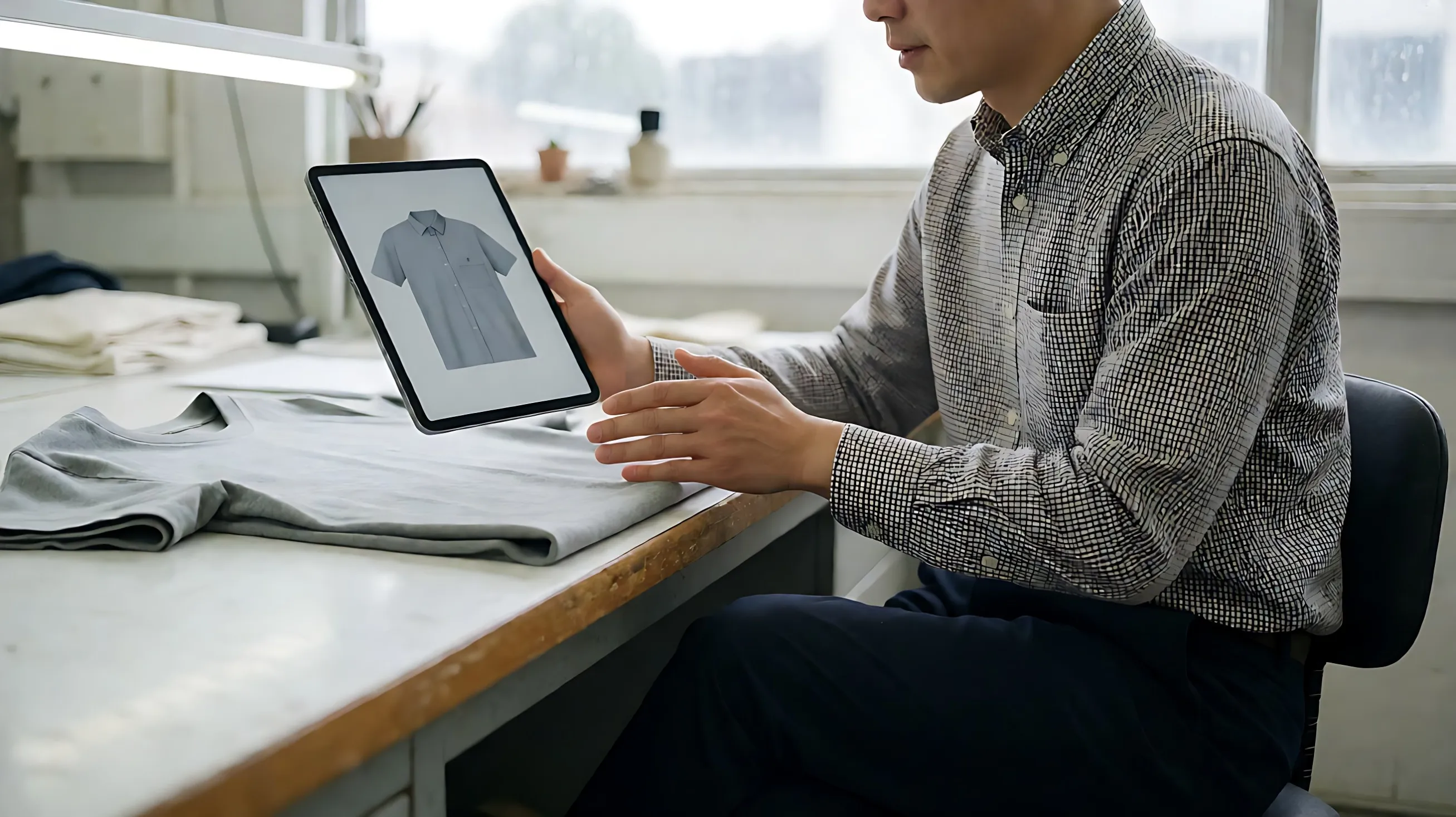
Short answer: the two approvals control different risks, so most orders use both in sequence. A digital mockup confirms design risk — placement, scale, spelling, garment colour — in hours. A pre-production sample confirms execution risk — how ink and thread behave on the real fabric — and adds a sampling round of [XX] days. Route by risk: repeat orders and simple one-colour logos can safely stop at the mockup; first-time programmes, multi-colour logos and strict brand colours should not cut bulk before a physical sample is signed.
Below, the decision in four parts: what a mockup can prove, what only fabric can prove, how to route your order, and what either route must put in writing.
What can a digital mockup actually confirm?
A mockup is a specification document that happens to look like a photo. Use it to confirm the logo version is current, the spelling is right, the placement matches your request, the scale reads correctly against garment size, and the garment colour is the one you chose. These are decisions, and decisions belong on screen where they cost nothing to change.
Reviewing it well takes discipline more than time:
• ☐ Open it at actual size on a computer, not a phone — small text and tight spacing hide on small screens
• ☐ Read every character aloud, including taglines and the backs of numbers
• ☐ Check each decoration location you ordered appears — chest, sleeve, back, nape label
• ☐ Confirm placement is called out from a fixed point (collar seam, shoulder seam), not "looks right"
• ☐ Name the Pantone reference for each print colour and record it on the proof
• ☐ Date the proof and have a second person review it before sign-off
True or false
✔ True: a mockup and a sample control different kinds of error. The mockup kills specification mistakes before any fabric is cut; the sample validates how the approved specification behaves on real material. Used in sequence they close most of the gap between "what was shown" and "what shows up".
✘ False: a realistic 3D rendering removes the need for a sample. Renderings keep improving, but a screen emits light while a garment reflects it through dye and thread. The gap is widest exactly where buyers care most: dark fabrics and large solid colour blocks.
What does only a physical sample prove?
Fabric is where mockups go blind. A pre-production sample shows you things no render carries:
• What to inspect · Why the mockup could not show it · How to check
• True colour on the fabric · Screen light vs dyed fabric · View under normal workplace lighting, not a lamp
• Fabric weight and hand feel · A flat image has no weight · Compare against the agreed fabric spec
• Stitch density and puckering · Stitch meets fabric only on the machine · Lay flat, stretch gently, look at the edges
• Small text legibility · Screens sharpen small type · Read at normal viewing distance
• Placement on a worn body · Mockups ignore drape · Put it on someone of a mid-range size
• Wash behaviour · Time does not exist in a mockup · Wash once per the intended care instructions before signing
Then ask the question most buyers skip: is this sample representative? A sample made on a substitute colour, a different fabric blend or a different decoration setup confirms general quality — not your bulk order. Ask directly whether the sample uses the same fabric lot, the same decoration method and the same thread or ink family planned for production. If it does not, treat it as a dress rehearsal, not an approval.
Take away: a sample only earns its [XX] days if you inspect it against the bulk plan — lighting, measurements, one wash — and confirm it was made the way the bulk will be made.

How do you decide which approval route your order needs?
Decide by risk, not habit. Score the order against five factors:
• Factor · Mockup approval is enough · Add a pre-production sample
• Order history · Repeat order with specs on file · First order with this supplier
• Logo complexity · One colour, bold shapes, no small text · Multi-colour, gradients, thin lines, small lettering
• Garment · A fabric and style decorated before · New fabric, stretch knit, fleece, curved or ribbed panels
• Colour sensitivity · Normal variance acceptable · Strict brand colours, dark fabric, large solid blocks
• What a mistake costs · Small run, quick reprint · Large run or hard deadline — one defect multiplies
Two of these deserve weight. Multi-colour logos on dark fabric are where screen and dye disagree most. And large runs turn every missed detail into a multiplied cost — the sample fee looks small next to redecorating hundreds of pieces.
If you are mid-way between routes, remember the mockup is free to revise and the sample is not. Push every placement and layout decision onto the screen first, so the physical sample confirms decisions instead of discovering them. Our
sampling checklist
walks each stage and what to sign at it.Take away: the riskier the order, the earlier a physical sample pays for itself. Simple, familiar, small — a well-reviewed mockup can carry it.

What should the approval put in writing either way?
Whichever route you take, the approval is only as strong as its paper trail. The written record should carry: the date; the garment style and colour; the logo version; the decoration method; dimensions and placement measured from fixed points (our
print placement tolerance guide
explains the convention); Pantone references and the agreed tolerance band (see Pantone matching and colour tolerance
); and the name of the person who signed.That record is what makes the sixth-month reorder match the first run — and what settles any dispute about what was approved. Custom goods generally cannot be returned, so the approval document, not a verbal ok, is your protection (the same logic as
written specs for non-returnable orders
).Take away: the dated proof is the contract; the mockup or sample is just its exhibit A.

Frequently Asked Questions
Can I skip the pre-production sample entirely?
Yes, when risk is low: repeat orders, simple one-colour logos on a proven garment, small runs. Skip it because the risk is genuinely low, not because the schedule is tight — an unplanned reprint costs more than the round you saved.
What does a pre-production sample cost?
Usually a sampling fee plus courier time, quoted per programme. Ask for both numbers in the quote before approving, and ask whether the fee is credited against the bulk order.
How long does the sample round take?
Budget [XX] days for making plus international courier time on top — the quote should state it per destination. Build it into the backwards timeline from your delivery date rather than treating it as a delay.
Does a photo of the sample replace inspecting it?
No. A camera shifts colour, scale and texture the same way a monitor does. Photos document the sample; they do not replace viewing it under normal lighting and handling it.
Who signs off the mockup on the supplier side?
Ask who checked it — a named person in production, not just sales. When both sides have a named signer and a date, "I thought you approved it" stops being an argument.
Not sure which route your order needs?
Request a Quote
with your logo, garment and quantity, and the quote comes back stating the approval route, the sampling fee and the round-trip time in writing.FACTS