Oct 3, 2026
How Does Ordering Custom Apparel Work? Six Gates
Six gates from idea to delivery: brief, quote, sample, purchase order, production, delivery — the decision and the written artifact each gate owes you before you move on.

Short answer: six gates — brief, quote, sample, purchase order, production, delivery — and each gate owes you one decision and one written artifact before you pass it. The full route runs [XX] weeks minimum from approved design to delivered goods, and sampling is the stage that actually flexes. Miss a gate's artifact and the mistake surfaces at the next gate, where it costs more.
• Gate · You decide · You should hold afterwards
• 1. Brief · Garment, quantity, decoration, date · A one-page brief anyone can quote from
• 2. Quote · Which supplier, at what structure · Quotes normalised to the same lines
• 3. Sample · Approve or revise · A signed physical sample, both sides
• 4. Purchase order · Tolerances and remedies · The PO with spec appendix
• 5. Production · Release bulk or hold · Inspection results against the sample
• 6. Delivery · Accept, claim, or distribute · Delivery notes and the reorder file
Most "how to order" guides stop at designing a shirt in an online tool. That works for twenty event tees. A team or uniform order is a procurement project, and this is the procurement version — the same six steps Chinese group-order buyers summarise as 需求确认、设计打样、下单生产、收货验收, each with its own failure mode.
Gate 1 — How do you turn "we want shirts" into a brief?
A quotable brief names four things: the garment type and colour direction, the quantity band, the decoration (print, embroidery, personalisation), and the date the goods must be in hand. Design files are welcome but not required at this stage — suppliers draft artwork as part of quoting, and a rough sketch with placement intent beats a polished file with no context. The brief's job is to make two quotes comparable; anything left vague comes back priced in the supplier's favour.
Take away: one page, four facts, date included. If a supplier can quote from your brief without calling you, the brief is done.
Gate 2 — How do you compare quotes that do not match?
Normalise before comparing: ask each supplier to quote the same lines — garment, decoration per location, setup charges, sample fee, freight, and the minimums behind them. Unit price alone hides the structure;
what your unit price is made of
breaks the four variables, and the MOQ guide
covers what the minimums bind. Two quotes on the same lines differ honestly; two quotes on different lines differ invisibly.Take away: the lowest number usually wins only because it counts the fewest things. Restructure the quotes, then choose.

Gate 3 — What does approving a sample actually lock in?
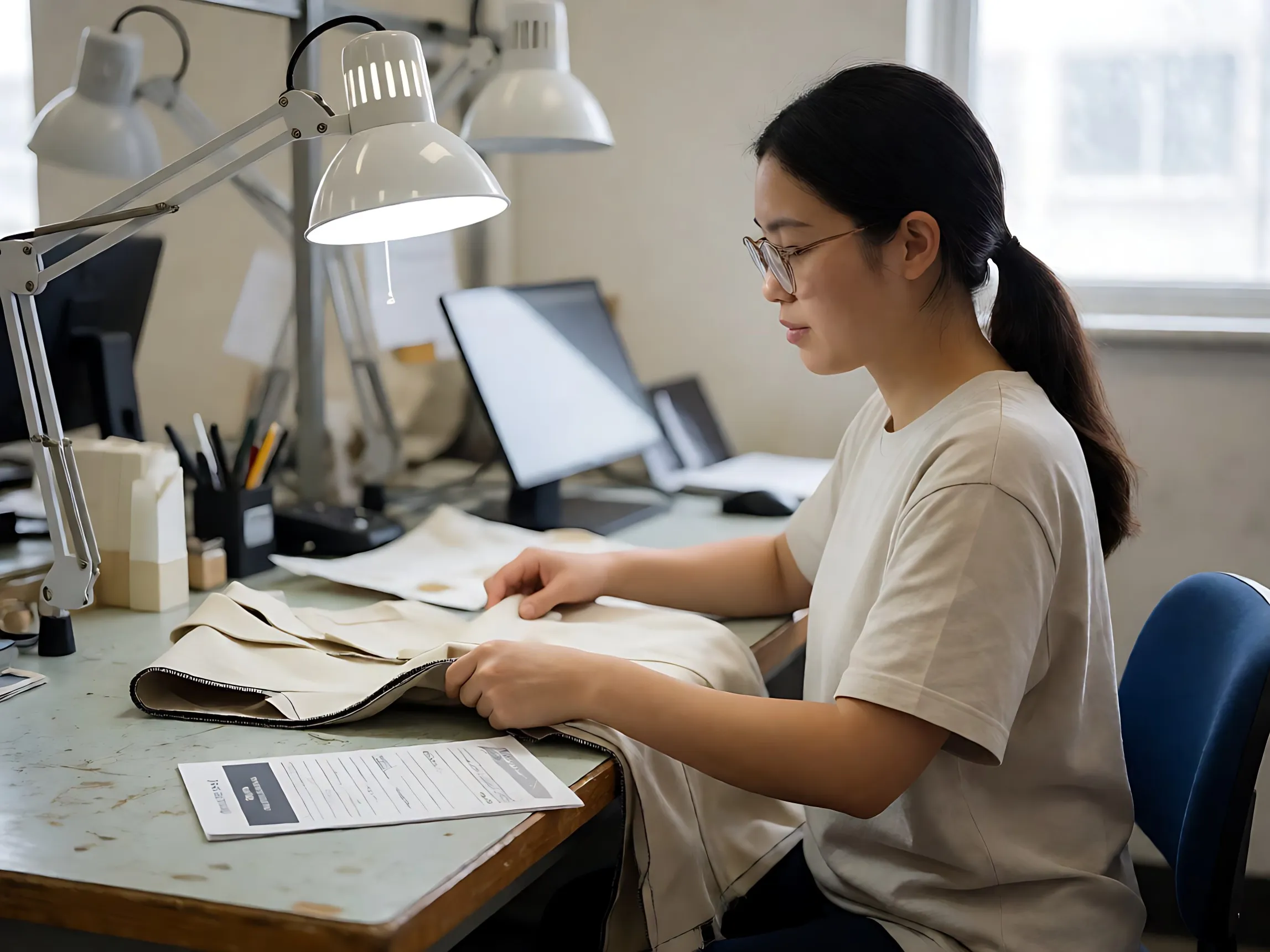
The sample stage answers "will the goods match what I approved" — and the signature is the mechanism. A signed, dated sample on both sides becomes the acceptance benchmark for bulk: colour on the actual fabric, print placement measured in centimetres (
print placement tolerance
), garment measurements against the size chart, and fabric you have touched (the sampling checklist
covers the full sequence). Approving from photos alone is the weakest form of this gate; physically inspect the sample or accept the risk knowingly.Take away: the sample is not a courtesy — it is the contract's physical form. No measurement, no release.
Gate 4 — What goes in the purchase order?
The PO is where casual orders become controlled ones. Four blocks: the spec appendix (fabric fields, decoration,
size break with tolerances
); the inspection terms (AQL sampling
); the remedy ladder for faults (why custom orders cannot be returned
); and the calendar, working backwards from your date (the lead-time timeline
). Anything not in the PO is a conversation; anything in it is a clause.Take away: custom garments are irreversible by nature — the PO is the only place that irreversibility gets negotiated. Write the four blocks before the deposit moves.
Gate 5 — What happens during production, and what can you still change?
Production has one useful checkpoint from your side: the mid-run or pre-shipment inspection, pulled from bulk and judged against the signed sample. Before production starts, changes are cheap; during cutting, changes are re-runs; after decoration, changes are a new order. Ask what curing and wash verification runs on printed goods (
print durability
explains the tests), and hold release until inspection passes.Take away: the last cheap change is the PO signature. After that, your control instrument is inspection, not requests.

Gate 6 — What should delivery leave you with?
Three artifacts close the loop: delivery notes checked against the PO (counts, sizes, personalisation against the
roster proof
); a claims record for anything outside tolerance, reported inside the agreed window; and the reorder file — signed sample reference, spec sheet, size break — so round two starts at Gate 2, not Gate 1. Importing for the first time also lands customs obligations here (the importing guide
covers importer-of-record and documents).Take away: a delivery that produces no reorder file has cost you the cheapest advantage in custom apparel: never re-specifying what you already specified.
Frequently Asked Questions
How long does the whole process take?
Budget [XX] weeks from approved design to delivery as a floor: sampling flexes most, production is the fixed block, freight is the deadline risk. The
backwards timeline
turns your date into the latest possible order day.Do I need my own design before asking for a quote?
No — a brief with placement intent is enough to quote. Bring files if you have them; expect the supplier to prepare print-ready artwork as part of the order, and to show you a proof before sampling.
What files do I send for the design?
Vector artwork when it exists; otherwise the highest-resolution file you have, with fonts and colours named. The supplier's pre-production team converts, and the proof is where you verify what the conversion did.
Can I see a sample before production?
Yes, and on any order meant to outlive one wearing, you should — the sample is the acceptance benchmark for bulk. Small one-off runs sometimes skip it; that is a risk decision, not a saving.
What happens after I approve the sample?
Bulk production runs against that signed sample, inspected to the PO's terms. Past that point, every change is a priced variation on its own schedule — approve slowly, then let it run.
How much input do I have on fabric and fit?
More than most buyers use: weight, blend and finish are specifiable fields (
how to specify fabric, GSM and blend
), and fit comes from the size block you choose, verified by a measured sample.What if the delivery date starts slipping?
Escalate at the first missed internal milestone, not at the deadline: ask for the mid-run inspection to be moved up, split the shipment so essentials travel first, or trigger the rush decision while it still helps. Silence is the only fatal option.
Checklist: the six artifacts
☐ One-page brief (garment / quantity / decoration / date)
☐ Quotes restructured to the same lines
☐ Signed sample retained on both sides
☐ PO with spec, inspection, remedy, calendar blocks
☐ Inspection results against the sample
☐ Reorder file saved for round two
First team order on the calendar?
Send the brief through the
quote form
— it returns normalised, with each gate's artifact attached. Or review the sample-kit route
to hold fabric and print quality before committing.FACTS